

Founded in 2019, Appsmith is one of the better-known modern low-code platforms. Specifically, it’s a popular option for building internal tools without the need to hardcode interfaces from scratch.
However, a lot has changed since 2019. In particular, the rise of generative AI has greatly altered the landscape for internal tool builders.
Today, we’re examining one important corner of this space by checking out the market for the top Appsmith alternatives.
Specifically, we’ll be covering:
Let’s start with the basics.
What is Appsmith?
Appsmith is an open-source low-code platform that enables developers to create interfaces, CRUD apps, internal tools, dashboards, admin panels, and workflows using primarily visual experiences.
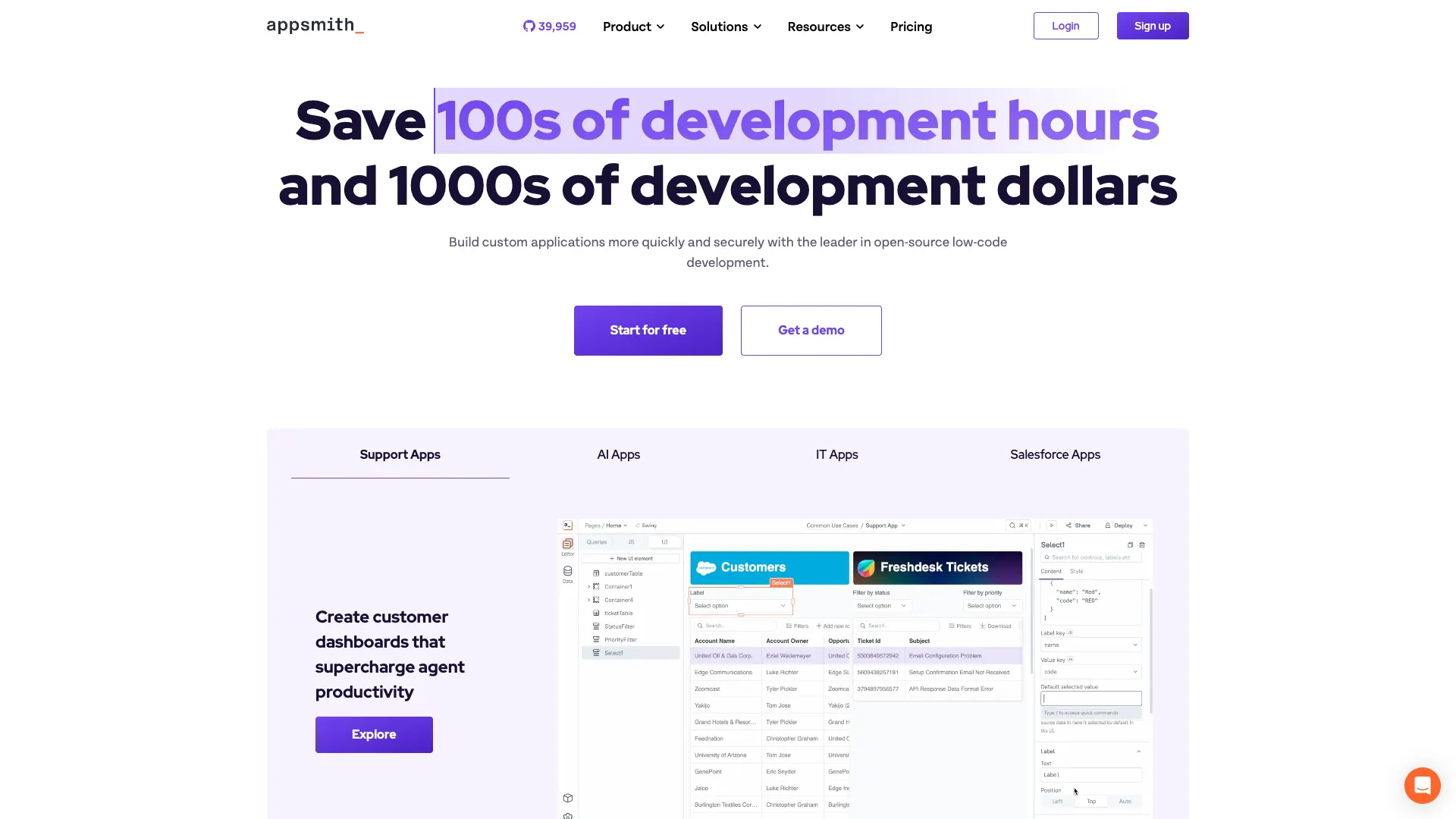 (Appsmith Website)
This includes a suite of tools for connecting to databases, APIs, and third-party services, alongside drag-and-drop UI components, JavaScript-based customization, role-based access controls, and deployment options for cloud or self-hosted environments.
In large part, the goal is to empower teams to build internal software more quickly and with fewer development resources.
In recent years, Appsmith has also introduced a range of AI capabilities within the platform.
This includes the ability to connect to a range of LLMs to perform multiple actions, including text generation, image generation, and more.
So…
Why would we need an alternative to Appsmith?
The low-code market has always been fairly varied in terms of the kinds of users and use cases that individual platforms target.
One important thing to note here is that Appsmith generally skews more towards the developer-focused end of this spectrum.
For example, the experiences for automating workflows are largely code-based, while in many other platforms there’s a bigger emphasis on visual development and drag-and-drop. This has the potential to be a limiter for many less technical users.
As we said earlier, the low-code market, especially for internal tool builders, has shifted massively in recent years. As such, most low-code platforms have had to adapt by introducing AI capabilities.
In Appsmith’s case, while AI actions are available across the platform, many teams will want to look elsewhere for many AI use cases, especially agent-building. While Appsmith Agents were announced in 2025, at present, they only appear to be accessible via a contact sales form, rather than being available to users more generally.
Additionally, as with any software procurement decision, pricing is a huge consideration here. That is, individual platforms have their own distinct pricing models, including restrictions on specific features across different tiers.
So, the platform that’s most cost-effective will generally vary from one team and use case to the next.
7 Appsmith alternatives for 2026
With a better grasp of what Appsmith is and some of the core reasons we might consider other options, we can begin to check out the specific alternatives that are available on the market today.
As we hinted at earlier, the low-code market is generally fairly varied, with different vendors often optimizing their platforms for quite specific use cases, teams, and personas.
We’ve chosen a range of tools from across the market to reflect this variety. Specifically, our picks are:
1. Budibase
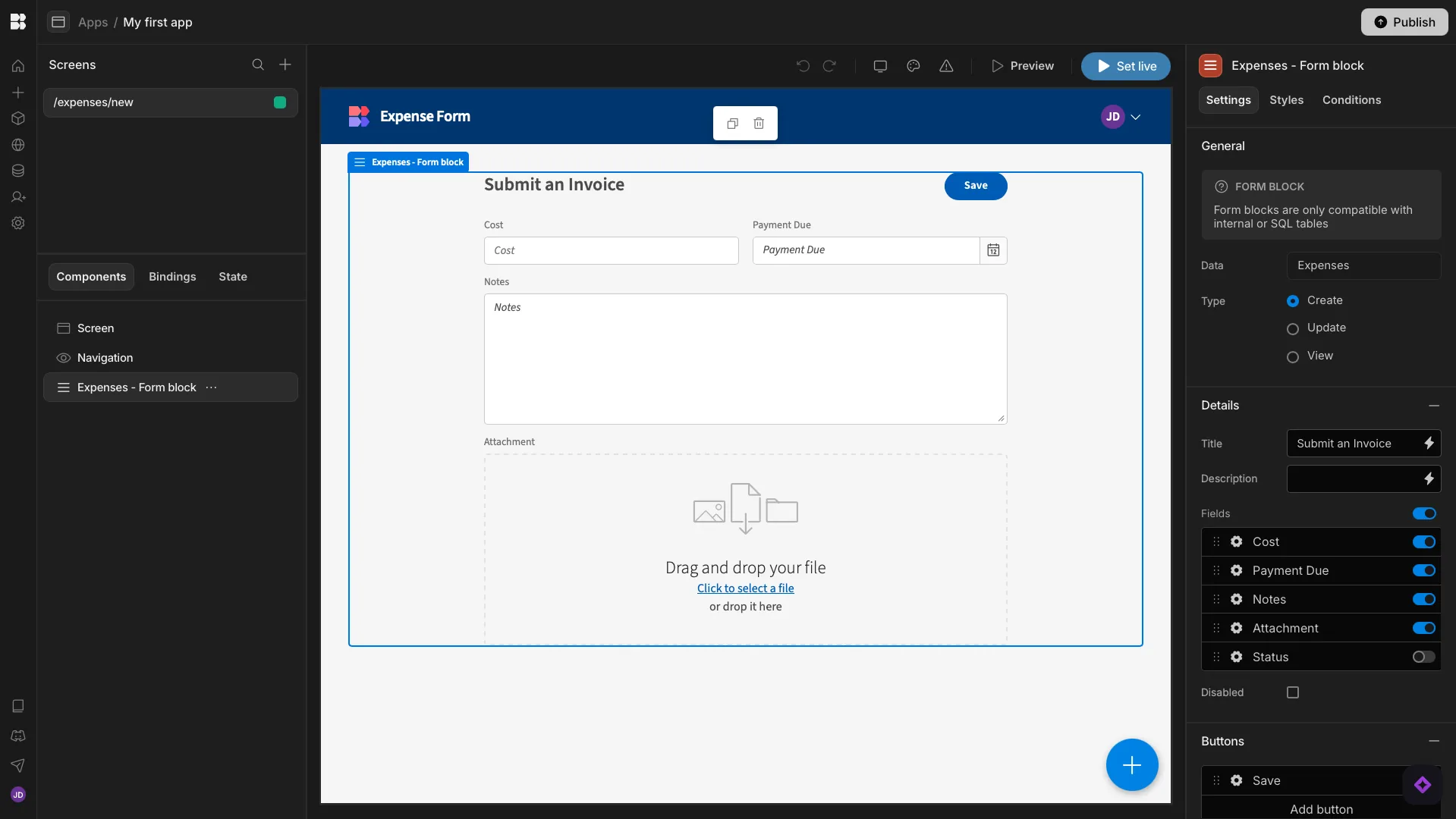
First up, Budibase is the all-in-one open-source AI workflow toolkit for building Agents, Apps, and Automations, using any data, LLM, or API.
Features
Budibase is built for teams that want to transform real internal workflows. As part of this, Budibase connects seamlessly to all kinds of RDBMSs and NoSQL data, along with connectivity for any LLM with an OpenAI-compatible API and REST templates for a huge range of business tools.
We recently launched Budibase Agents into Beta, offering an intuitive, instruction-led experience for building intelligent agents that can interact securely with your tools and data and be deployed to existing chat tools, including Slack.
Budibase also offers dedicated App and Automation-building tools, including auto-generated CRUD and form UIs for connected data sources, as well as a range of configurable automation triggers, actions, and logical operators.
Join 300,000 teams running operations on Budibase
Get started for freeUse cases
Our users choose Budiabse for all kinds of internal tool projects, including building forms, approval workflows, CRUD tools, admin panels, and much more. There’s never been an easier way to ship professional internal tools with minimal custom code.
Budibase is also the smart choice for security-first teams. With optional self-hosting, custom RBAC, SSO, air-gapped deployments, and more, it’s the perfect solution for transforming mission-critical operations.
Take a look at our pricing page to learn more.
2. ToolJet
Next up, we have ToolJet. This is perhaps one of Appsmith’s most direct competitors, offering a suite of tools for creating internal tools and agents that connect to existing systems.
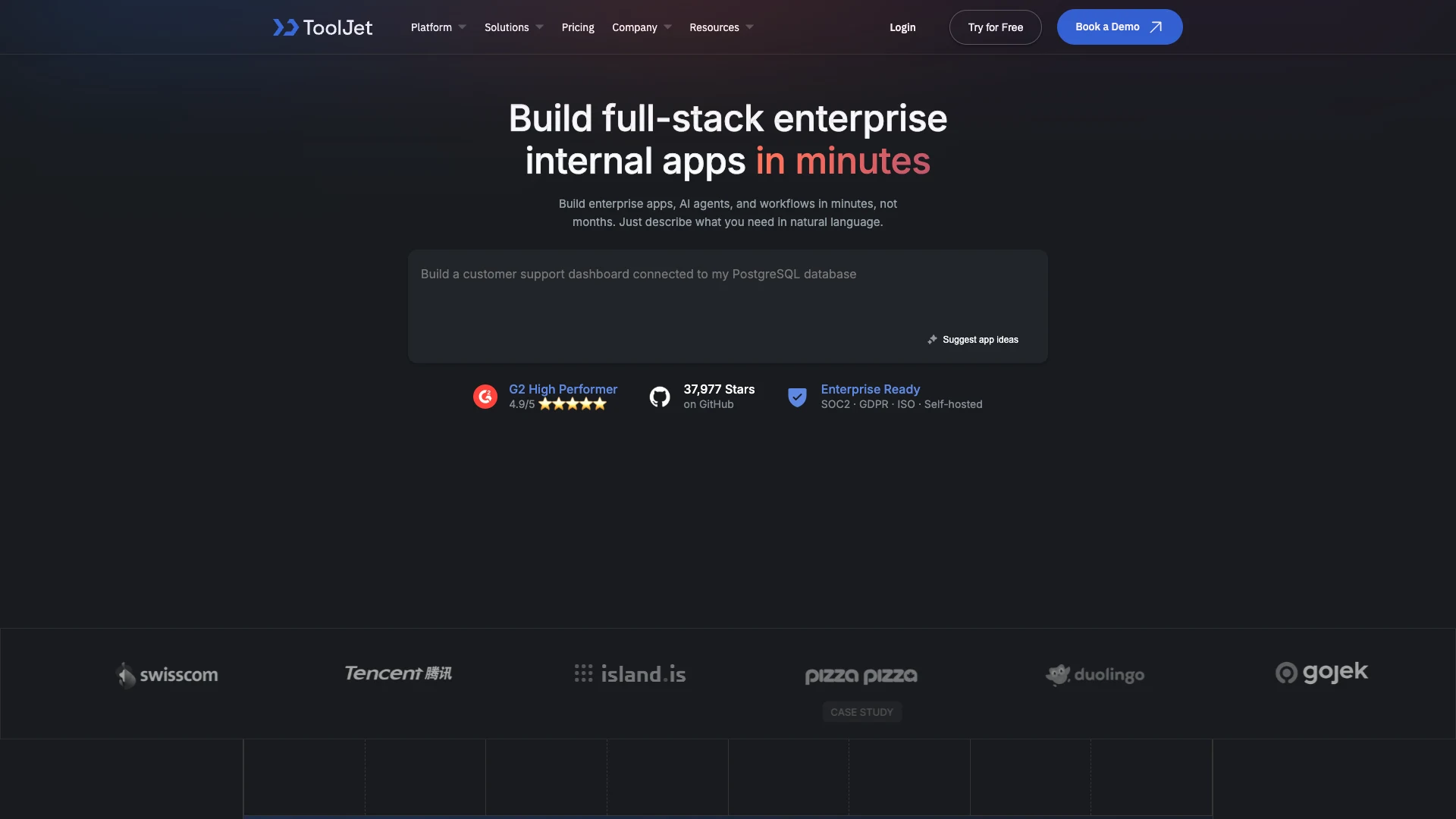 (ToolJet Website)
One standout feature here is the ability to generate working apps using natural language. This has the potential to greatly speed up development tasks, including by providing an auto-generated basis for further customization.
ToolJet is also well-regarded for offering a strong combination of customization options and streamlined experiences. In particular, it’s a popular choice for building professional apps without requiring as extensive custom code as some other Appsmith alternatives.
Like most tools in this space, the core app builder centers around a drag-and-drop experience for configuring prebuilt components. There’s also strong scope for custom Python and JavaScript, as well as the ability to add custom React components.
ToolJet also offers useful lifecycle management functionality. This includes a range of tools to help us draft and iterate over solutions, as well as for handling releases and rollbacks, and separate development and production environments.
ToolJet’s agent building experience is contained within the core automation tools, using the Agent node. This offers a flexible, intuitive way to create AI-powered systems and connect them to external platforms with drag-and-drop design tools.
On the whole, it’s a capable app-building platform, although some teams may wish to explore other Appsmith alternatives for a dedicated agent builder or more in-depth code-based customization.
3. Outsystems
Outsystems is one of the most widely adopted enterprise low-code platforms, offering extensive solutions for creating both internal and external-facing apps, agents, and more.
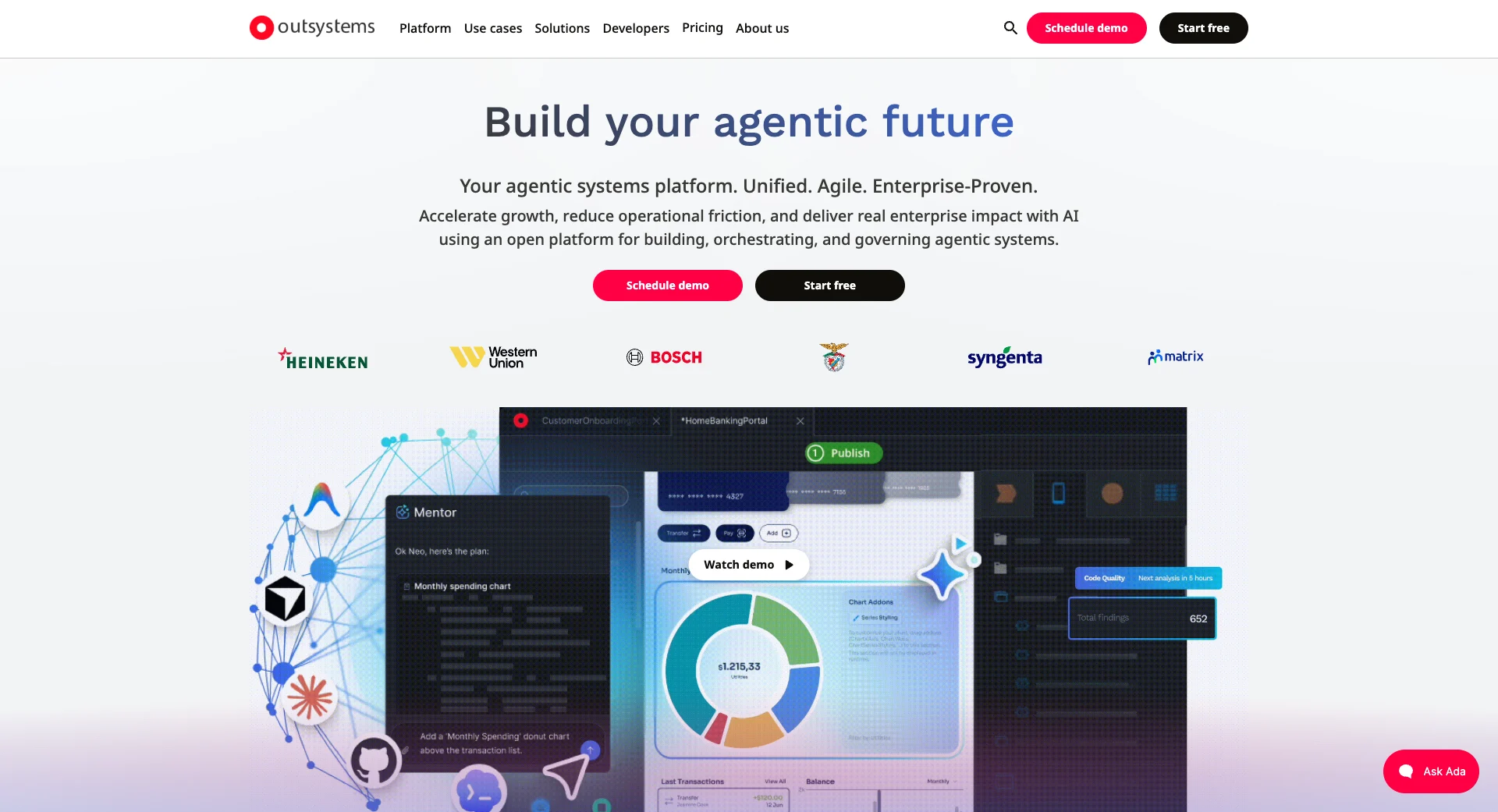 (Outsystems Website)
In recent years, Outsystems has focused heavily on empowering enterprises to adopt AI. As such, the platform offers a wide range of capabilities, including building AI-powered workflows, orchestrating code-based agents, handling multi-agent workflows, and implementing human-agent collaboration.
Alongside this, Outsystems is a strong option for large teams that need to build secure AI systems. This includes DevSecOps capabilities and a range of built-in security and governance tools.
More directly as an Appsmith alternative, Outsystems has also long been a popular platform for creating custom applications using low-code. Unlike many other tools in this space, it’s highly optimized for both internal and external apps, making it a strong choice for use cases such as public service portals.
Naturally, it’s also a highly capable platform in terms of integration with enterprise systems, including support for a massive range of databases, software platforms, LLMs, and MCPs.
OutSystems also offers a relatively high level of customization and flexibility compared to other platforms in the low-code space. This includes extensive scope for custom code, a range of SDKs and libraries, and the ability to use custom assets via the Forge marketplace.
As such, OutSystems is a very powerful platform, especially for large organizations. However, it’s worth noting that we might need somewhat higher technical skills than some other Appsmith alternatives to make the most of it.
4. Mendix
Mendix is another well-established, enterprise-focused low-code platform that focuses heavily on enabling teams to output agents and apps.
 (Mendix Website)
Like Outsystems, it’s heavily positioned towards providing teams in large organizations with tools to adopt AI and facilitate humans and agents collaborating within workflows and processes.
As such, it offers extensive functionality including enterprise knowledge graphs, model deployment, agent development, governance, orchestration, and more.
Mendix is also a strong choice for teams that want to connect to their own tech stack within their own environment. It boasts a bring-your-own model approach, as well as support for on-prem hosting and air-gapped deployments.
As an Appsmith alternative, Mendix provides a comprehensive suite of app-building tools. This centers around Mendix Studio Pro, a low-code tool for modelling and creating applications.
One particularly impressive element of this is the Maia virtual assistant, which is able to provide information and answer questions for app builders, as well as automatically generating parts of their applications.
On the whole, Mendix is another strong option for teams in the market for an Appsmith alternative, although, like Outsystems, some of its capabilities may be overkill for teams with less advanced use cases.
5. Retool
Next up, we have Retool. A widely known platform in the low-code space, this is often typically seen as one of Appsmith’s most direct competitors.
 (Retool Website)
In fact, Appsmith has often been described explicitly as an open-source Retool alternative. As such, it’s one of the platforms we’ve seen so far that will feel most familiar to existing Appsmith users, which will be attractive for teams looking for a one-to-one replacement.
As an app-builder, Retool sits somewhat more towards the developer-focused end of the low-code spectrum. As such, it offers a high scope for adding custom code, including a full IDE.
This will make it an attractive option for professional internal tool developers, but it may also mean that certain less technical colleagues might struggle to make the most of the platform.
Like many other platforms in the low-code space, Retool has also invested heavily in AI capabilities in recent years. On the one hand, this includes enhancements within the existing app-building tools, including generation from natural language.
On top of this, Retool offers its own agent builder and tools for managing AI primitives that can be incorporated within apps and automations.
However, as an Appsmith alternative, it's worth noting that Retool is not open-source. While it is possible to self-host, this is restricted to enterprise licenses.
6. Power Apps
Part of the Power Platform ecosystem, Power Apps is Microsoft’s low-code platform.
 (Power Apps Website)
Power Apps is a popular option for developers and business-level users alike, offering a strong combination of flexibility and ease of use. This centers around a combination of drag-and-drop, code-based building, and natural language-based experiences.
One of Power Apps' key selling points is governance. Specifically, it offers IT teams a range of tools for empowering citizen developers, including setting limits and providing templates to get started with their use cases.
As you’d expect, Power Apps also benefits from a close integration with the wider Microsoft ecosystem, including Teams, SharePoint, Power BI, and other common office tools, as well as a wide range of third-party integrations.
In terms of AI capabilities, Microsoft’s Copilot is integrated across Power Apps, including for builders and end users. There are also additional UX enhancements, including AI-powered data entry as well as data analysis tools.
However, it’s worth noting that Power Apps is primarily an app-building platform, so if we want to build agents or automations, we’ll likely need Microsoft’s other related tools for these.
Power Apps is a great choice for citizen development use cases in large organizations that are already deeply embedded in the Microsoft ecosystem.
7. JetAdmin
Lastly, we have JetAdmin. This is a slightly different proposition from most of the other Appsmith alternatives we’ve seen so far, billing itself as a no-code platform.
 (JetAdmin Website)
As such, it could be a good option for teams that want to build custom internal tools and agents without requiring extensive development skills or knowledge.
Like some of the other tools we’ve seen, we can automatically generate custom apps by entering natural language, providing a useful starting point for building a range of use cases including admin panels, dashboards, portals, and more.
JetAdmin is also a good choice for teams with more specific needs in terms of UI design. Specifically, it offers a no-code designer for custom components, as well as integrations with Figma and Sketch.
There are also tools for creating AI agents that can connect to existing tools, data, and models. We can also connect these to existing communications channels, including Slack, Teams, and email.
On top of this, there is a range of AI assistant capabilities across the platform, powered by GPT-4.
As such, JetAdmin will be an attractive choice for a range of different types of use cases, although it's worth noting that some other Appsmith alternatives might offer us more extensive code-based customization and flexibility.
The all-in-one AI workflow toolkit
Budibase is the complete open-source AI workflow toolkit that empowers teams to build Agents, Apps, and Automations using their own data, LLMs, APIs, and infrastructure.
Take a look at our pricing page to learn more.