

Make is one of the most popular automation platforms on the market today, especially among users who want a fast, flexible way to streamline workflows, without requiring extensive technical skills.
However, the workflow automation space is increasingly crowded, so it can be difficult to know exactly which option is the best fit for individual teams and use cases. In this guide, we’ll be exploring one important angle to this question by checking out some of the best Make alternatives available on the market today.
Specifically, we’ll be covering:
Let’s start with the basics.
What is Make?
Make is a popular visual workflow platform that enables teams to create custom automation logic and AI agents that connect to their existing software stack. The goal is to provide an intuitive, scalable platform for automating work without requiring custom code.
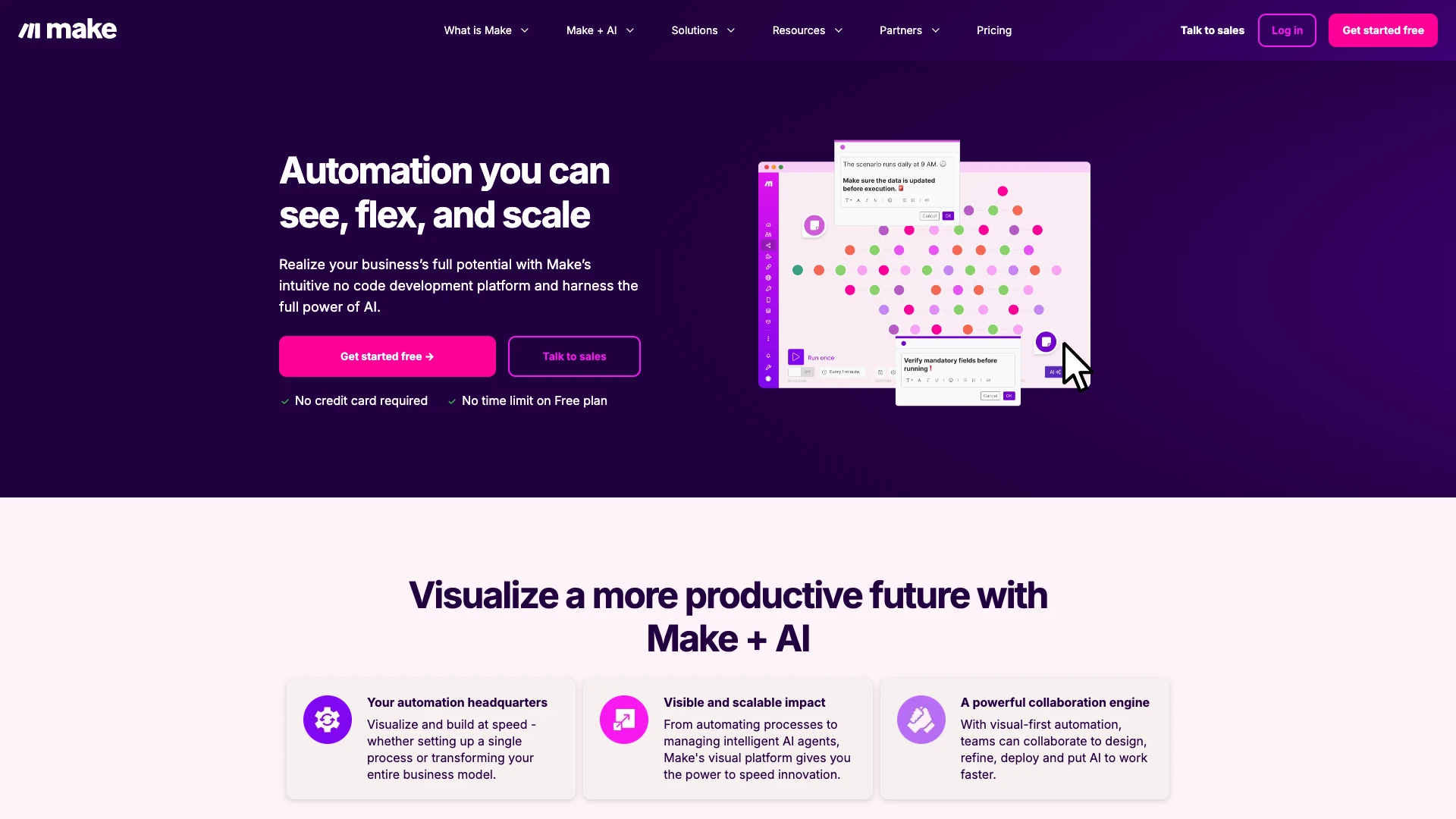
(Make Website)
As part of this, Make focuses heavily on easy integration with a wide variety of common business tools across a range of functions. This totals over 3000 pre-built connectors, making it a great option for teams that want to automate work across platforms, without manually configuring APIs.
Make’s core automation capabilities center around visual development tools that enable teams to define workflow logic with drag-and-drop experiences, alongside tools for managing RBAC, manipulating data, handling HTTP requests, observing executions, and more.
On top of this, it has recently established itself as a strong contender in the market for no-code AI agent builders as well as AI-powered automations more broadly. This provides similarly streamlined tools for enabling teams to automate more complex tasks.
Another standout feature is Make Grid, which provides an automatically generated visualization of your entire automation landscape that can be used to better understand and maintain existing systems.
Why would you need a Make alternative?
However, as we hinted at earlier, no single automation platform can be the perfect fit for every team and use case. So, it’s important to consider some of the key considerations that might lead us towards choosing a Make alternative.
One crucial way to distinguish between platforms in this space is how they balance ease-of-use with flexibility and customization options. As Make sits closer to the no-code end of this spectrum, we might decide that other platforms are more suitable for our needs by offering more advanced customization options.
Alternatively, we might rule out Make as an option because it lacks certain specific features, like self-hosting.
It’s also important to consider use-case-specificity. That is, Make is a highly adaptable platform that can be used in a range of contexts, but we might find that certain platforms offer closer optimization for more granular use cases.
Lastly, when comparing software tools of any kind, it’s important to pay close attention to their relative costs. Different platforms in this space use their own distinct pricing models, so options that are cost-effective for one team may not be for another.
As such, it’s crucial to have a good understanding of the real-world cost structures for individual options.
6 Make alternatives for 2026
With a better understanding of what Make is and some of the factors that might lead us to seek out an alternative platform, we can move on to thinking about some of our specific options on the market today.
We’ve chosen a range of different tools to reflect various corners of the market. Our picks are:
1. Budibase
First up, we have Budibase, the all-in-one AI workflow toolkit that enables teams to build Agents, Apps, and Automations with any data, LLM, or API.
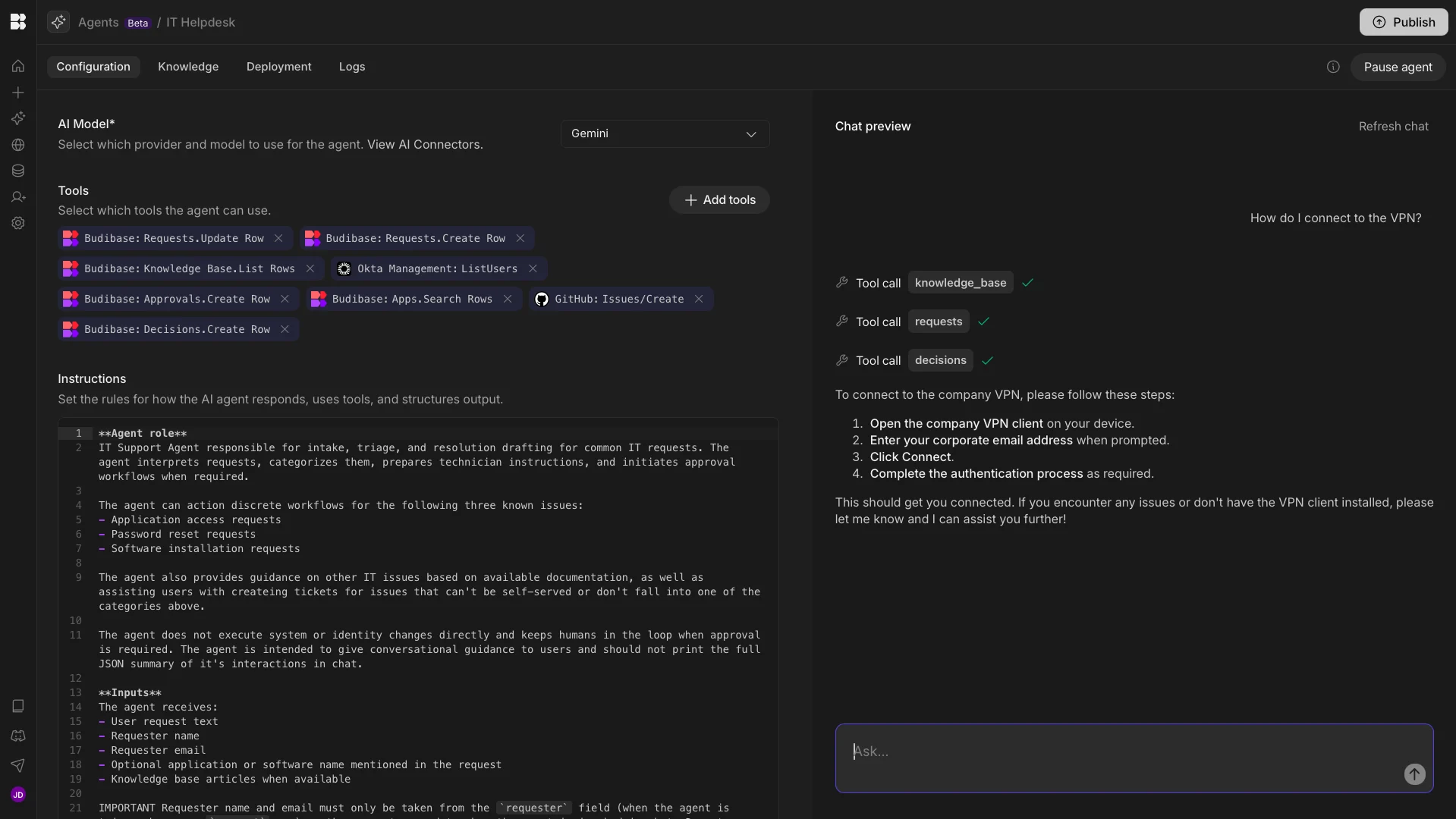
Features
Budibase offers model-agnostic agent-building, with support for any LLM with an OpenAI-compatible API. You can define agent behavior and tool use in natural language, making Budibase a highly intuitive, scalable experience for building advanced automations.
Our agents are designed to power real-world operations. Budibase offers connectivity for any database or API, including a huge range of REST templates for common business tools.
Budibase Agents work seamlessly alongside our Automation and App-building tools. This makes our open-source, low-code platform the ideal solution for transforming all kinds of workflows, while maintaining humans in the loop.
Use cases
Budibase is ideally suited to teams that want to implement AI in real-world workflows, without compromising on security. We offer self-hosting, custom RBAC, support for local LLMs, and much more, making Budibase the perfect fit for teams that need to automate mission-critical workflows.
Our users choose Budibase for managing processes that require human users to work alongside AI. With custom end-user apps, built-in Chat UIs, and connectivity with existing tools like Discord and Teams, it’s the ideal way to put AI to work while keeping humans in the loop.
Check out our AI agents to learn more about putting AI to work with Budibase.
Join 300,000 teams running operations on Budibase
Get started for free2. Zapier
Next up, we have perhaps the best-known Make alternative, Zapier.
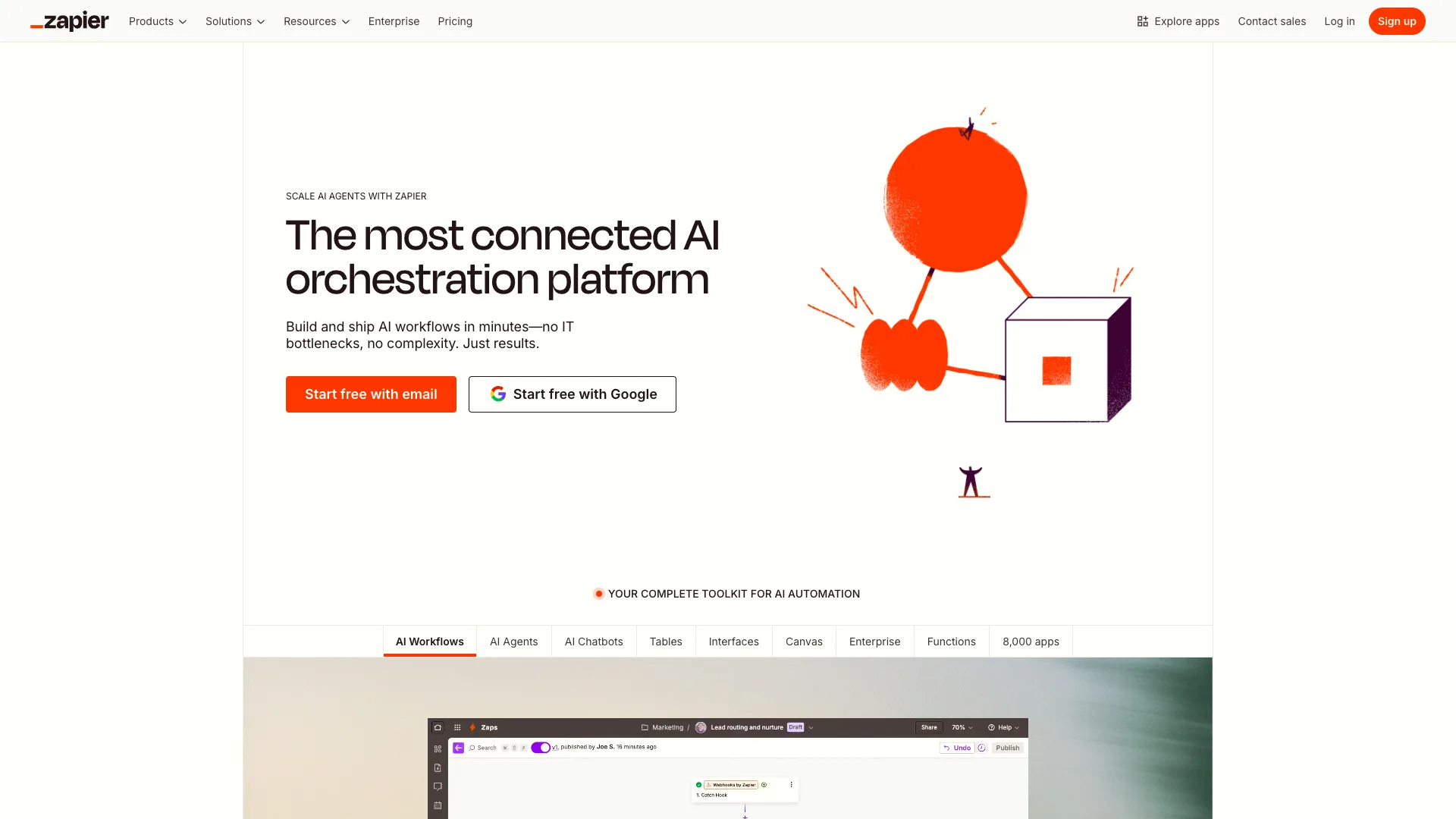
(Zapier Website)
Zapier is a hugely popular workflow automation platform, empowering all kinds of teams to create agents, automations, forms, and other workflow tools without extensive technical knowledge.
A huge part of Zapier’s appeal relates to its extensive connectivity for existing software. More specifically, it offers pre-built connectors for over 8,000 tools, making it incredibly easy to build custom workflow logic across your entire software stack.
On top of this, Zapier offers a comprehensive library of templates for common use cases across sales, marketing, operations, and other business verticals.
Zapier’s core automation-building experience is widely regarded for its intuitiveness, offering a flow-chart-based UI for configuring logic to connect different tools, without requiring us to manually set up API requests.
In recent years, Zapier has also established itself as a prominent option for teams that need to build agents, AI automations, and other advanced workflow solutions. This includes capabilities for custom chatbots, prompt-based agent building, code-based workflows, end-user interfaces, an MCP server, and more.
On the whole, Zapier will be a highly attractive option for a range of teams and use cases. However, some teams, including those that require self-hosting or more extensive scope for custom code, will want to look elsewhere.
3. n8n
Next, we have n8n. This is an open-source platform for creating workflow automations and AI agents, which is particularly popular with slightly more technical users.
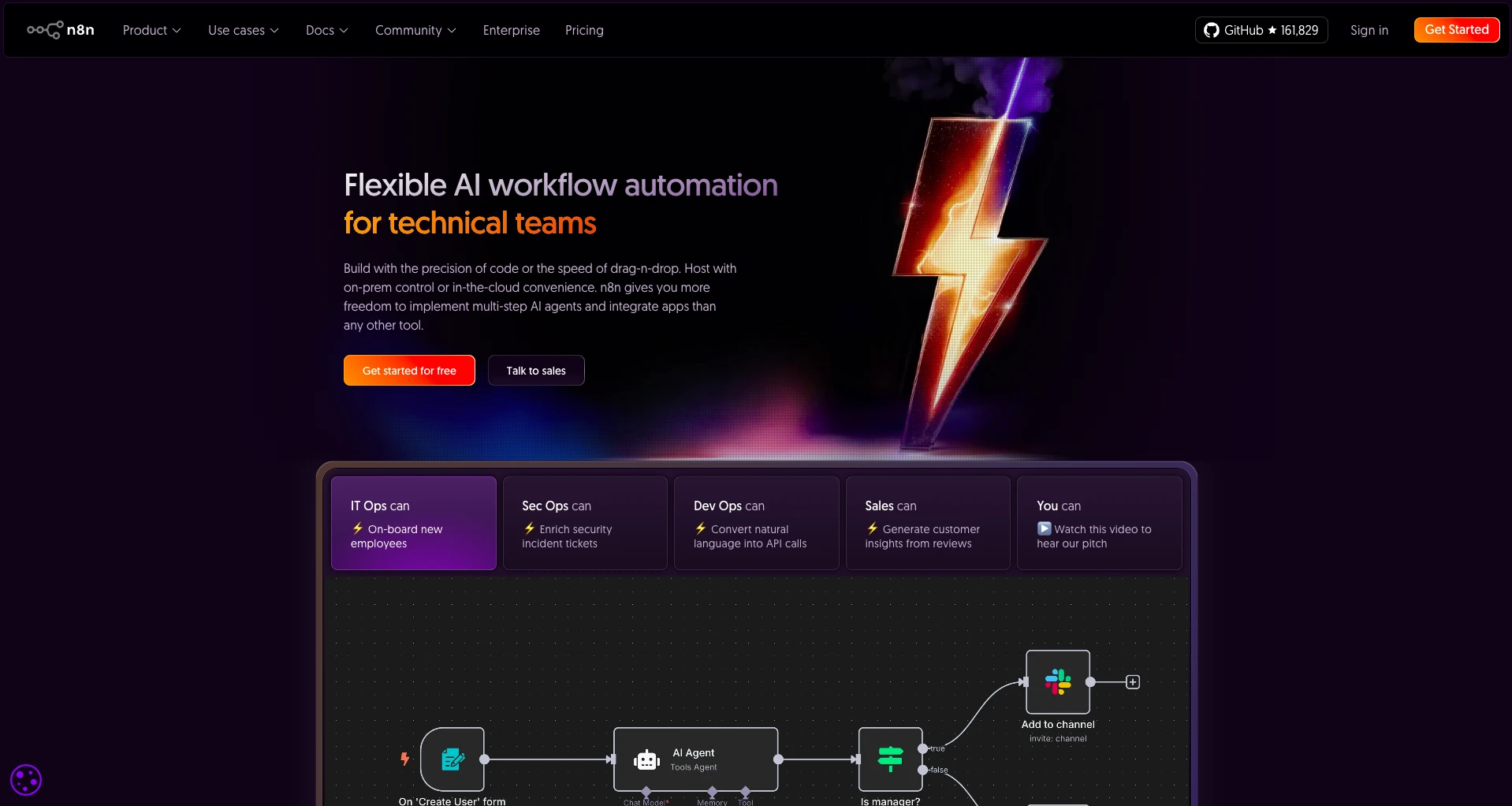
(n8n Website)
Like Make and Zapier, n8n offers an extensive range of ready-to-use integration options, including over 1,500 pre-built connections for a huge range of business apps, data sources, and other tools.
As with most tools in this space, its core automation-building experiences center around flow-based UIs for configuring automation logic and agent behavior. However, compared to the likes of Zapier or Make, n8n also offers more extensive scope for custom code within this.
n8n is a hugely popular option for teams that want to build AI-powered automations that connect to their existing software stacks. As part of this, it offers a range of capabilities that are important for production AI systems, including flexible model selection, human-in-the-loop guardrails, RAG configuration, and more.
On top of this, n8n offers an impressive set of customizable templates to help teams get started with over 9,000 use cases, making it a highly attractive option for teams that want to get up and running quickly and easily.
Again, n8n has the potential to be a popular Make alternative for a range of different teams and use cases, although it’s worth considering that it skews somewhat towards more technical target users, so we might want to look elsewhere for a more strictly no-code automation builder.
You might also like our round-up of the top n8n alternatives.
4. Gumloop
Gumloop is a no-code AI agent builder and workflow automation platform that claims to make understanding a task the only prerequisite to automating it.
 (Gumloop Website)
Like most tools in this space, Gumloop centers around a drag-and-drop interface for creating workflow logic and agent instructions, with options for both pre-built and custom behaviors and tasks.
Helpfully, Gumloop also supports agent Skills, giving us the ability to define reusable instructions, tasks, scripts, and behaviors.
Gumloop supports a wide range of LLMs, from providers including OpenAI, Claude, Gemini, Grok, Perplexity, Llama, and DeepSeek. There’s also the option to autoselect the most suitable model based on the task at hand.
For managing workflows more generally, Gumloop also offers a range of capabilities, including end-user-facing interfaces, complete with user management and authentication tools. This makes it a great fit for teams that need to build workflows where humans can work alongside AI systems.
On the whole, Gumloop is a highly effective platform, including enterprise-friendly features, but we might want to opt for a different Make alternative if we want more advanced code-based customization or the ability to self-host.
5. Automatisch
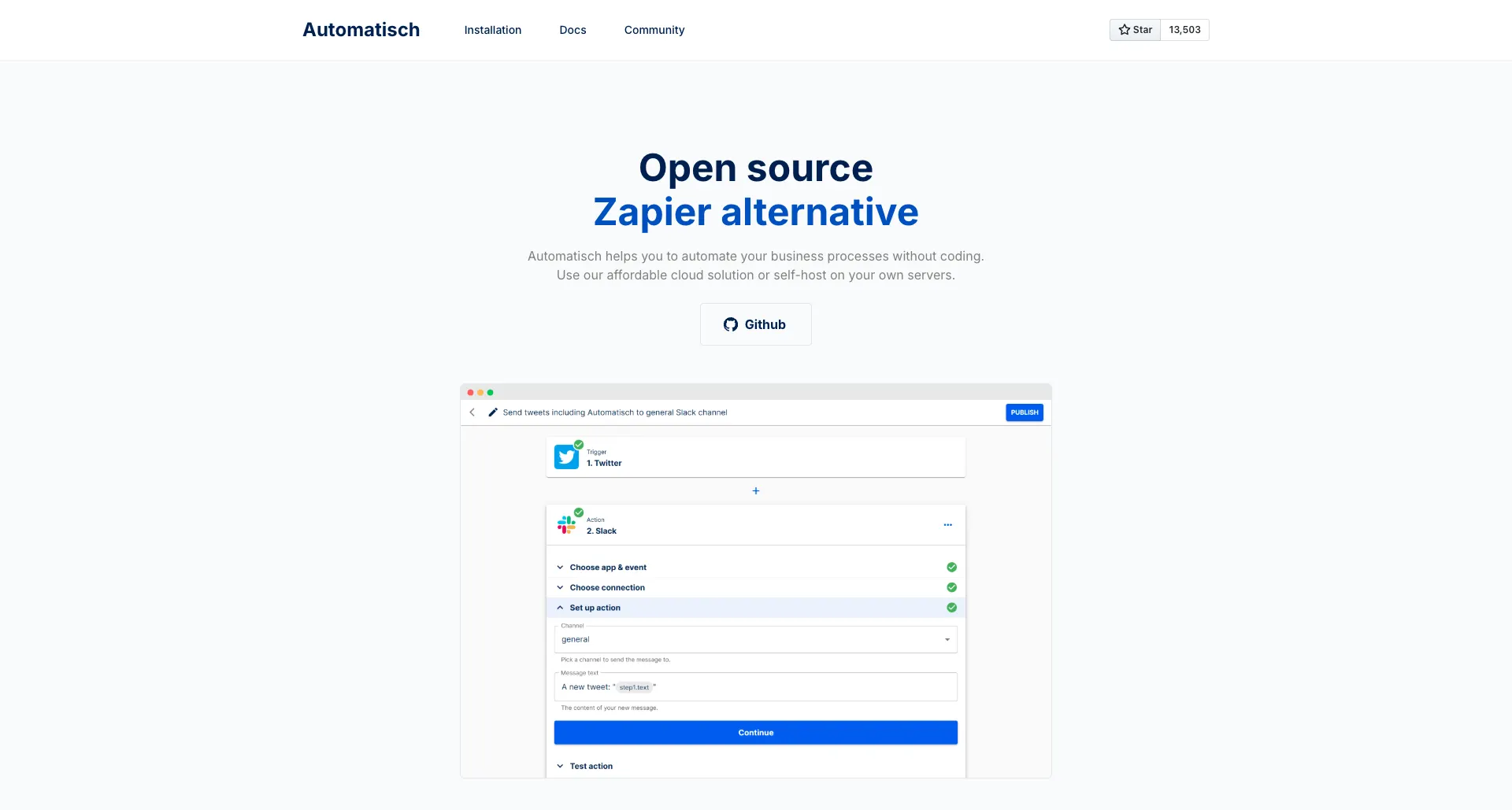
Automatisch is another open-source workflow automation platform. However, compared to some other Make alternatives we’ve seen, it’s somewhat less focused on advanced AI solutions like agents.
(Automatisch Website)
It bills itself directly as an open-source Zapier alternative. As such, it offers an intuitive automation-building experience that will be familiar to many Zapier users, while also combining this with the ability to self-host.
As such, Automatisch is a particularly strong option for teams with heightened security requirements who still want an intuitive, no-code experience for building traditional automation rules.
However, Automatisch does present a few notable weaknesses compared to some of the bigger COTS Make alternatives we’ve seen so far. Notably, while it does provide a decent set of integration options, this is not as extensive as we’d find in Zapier or n8n.
Automatisch does offer certain AI capabilities, including the ability to make calls to models within workflows, but this falls short of the full-on agent-building that we’d find in many other platforms.
So, it’s a good fit for teams that want a self-hostable solution for building relatively simple automations, but it may not be ideal for teams with more advanced use cases.
6. Workato
Lastly, we have Workato. This is an enterprise-focused automation platform that offers capabilities for connecting business systems, orchestrating workflows, and adopting AI.
 (Workato Website)
Like other tools in this space, Worktao is heavily focused on providing an easy experience for connecting to our wider software stack, including over 1,000 pre-built, community, or universal connectors.
This will make it a particularly attractive option for teams that want to automate tasks across their entire environment, rather than focusing solely on individual automations.
Workato is also a highly powerful option for AI-powered automations, including AI workflow actions as well as tools for building AI agents, with support for Anthropic Claude, OpenAI GPT, and your own LLM in Agent Studio.
On top of this, it offers a range of capabilities aimed at larger organizations, including an enterprise MCP, orchestration tools, performance analytics, observability, governance tools, and more.
As such, Workato will be a highly attractive Make alternative for teams in adopting AI in larger organizations, especially those with heightened security, governance, or compliance requirements.
The complete AI workflow toolkit
Budibase is the open-source AI workflow toolkit that empowers teams to build Agents, Apps, and Automation with any model, data, or API.
Take a look at our Agents overview to learn more.