

Demand for agentic AI has never been higher, but when it comes to real-world adoption, many organizations are still struggling. At the same time, more and more vendors are bringing agent tools to market. So, choosing the right solution for your specific needs can be highly challenging.
Today, we’re examining a key corner of this space by checking out some of the most prominent low-code AI agent platforms that are currently available on the market. These bridge the gap between fully custom systems and no-code builders, combining flexibility with comparatively quick, easy implementation.
Specifically, we’ll be covering:
- What is a low-code AI agent platform?
- What to look for in a low-code agent builder
- 6 low-code AI agent platforms for 2026
Let’s start with the basics.
What is a low-code AI agent platform?
As the name suggests, low-code agent platforms allow us to build and configure AI agents with varying degrees of optional custom code. The goal is to eliminate repetitive tasks required to build custom agents, enabling teams to focus on tasks like configuring behavior and tool use.
In addition to reducing the effort required to create agents, this also makes the agents we do build more maintainable and easier to manage.
However, as we’ll see a little later, even this subcategory of AI agent platforms has important variations within it. This can range from tools that enable users to add custom code in relatively limited ways to more deeply customizable platforms.
At their core, though, essentially all low-code agent tools are focused on enabling teams to connect to a variety of AI models, configure agent behavior, integrate with existing tools, and deploy and manage agentic workflows.
Low-code vs no-code agents
To better understand where low-code options fit into the market for AI agents, it’s worth considering how they differ from their no-code equivalents.
As you might imagine, the key distinction here is that, where low-code platforms enable us to utilize custom code when building agents, no-code tools are entirely focused on providing visual development experiences.
This has a few key practical implications. Importantly, no-code platforms naturally sacrifice some degree of flexibility, although this is often balanced by more user-friendly or intuitive developer experiences, especially for less technical teams.
Besides this, the ability to add custom code often introduces a few important capabilities, including the ability to configure custom integrations or define agent actions using code in languages such as JavaScript or Python.
You might also like our guide to choosing a no-code AI agent builder.
What to look for in a low-code agent builder
Before we move on to checking out some of the specific low-code agent builders that are available today, it’s also important to have an understanding of the kinds of decisions we’re likely to encounter when considering our own requirements.
As with any software procurement decision, individual vendors target distinct market segments. This means that their products are generally optimized for different kinds of target users and solutions.
Here’s what we need to know.
Types of agent builders
A helpful place to start here is to consider some of the broad categories that we can place low-code AI agent platforms into. As we do so, it’s worth keeping in mind that these are only illustrative, and in the real world, there’s a fair degree of overlap between them.
Firstly, there are workflow-focused platforms. These primarily focus on enabling users to connect models, automation actions, data, and APIs to build agents for managing specific internal tasks.
These might be invoked as back-end automations or via chat UIs.
There are also more explicitly chat-focused tools, which aim to empower teams to build custom conversational assistants. These may also include workflow elements, as well as supporting RAG for documentation and other knowledge sources.
Besides this, there are also some more granular platforms, aimed at functions such as orchestration and observability.
Features and decision points
As well as categorizing low-code agent platforms by their core use cases, it’s important to understand some of the key functional requirements we might have, and the decision points these can lead to when evaluating different options.
One of the most important factors here is model support. That is, the LLM that we choose to power an agentic has huge implications for its running costs, performance, and a range of other factors, including security and data residency.
So, many teams prioritize platforms that offer high levels of flexibility in terms of model selection.
Similarly, integrations are critical when selecting a low-code AI agent platform, both in terms of the range of connections available and the experiences for connecting to external tools. In short, we’ll need to select a platform that’s capable of connecting to our wider software stack in a manner that suits our core users’ technical skill levels.
Hosting options can vary across individual low-code agent builders, with different options suiting different types of organizations. So, some are wholly cloud-based, offering a high degree of convenience, while others are self-hostable, providing additional control and flexibility.
If we want to build agentic workflows, we’ll also want to consider individual platforms’ wider capabilities here, including whether we can build deterministic automations, end-user apps, or other human-in-the-loop controls.
And of course, as with any other software procurement decision, we’ll need to pay close attention to pricing. Most platforms in this space offer usage-based pricing, but the specifics of this can vary, meaning that the tool that’s most cost-effective can vary from one team or use case to the next.
6 low-code AI agent platforms for 2026
With a better understanding of what the market of low-code AI agent platforms looks like and what we might be looking for, we can move on to thinking about the specific platforms that are available today.
We’ve chosen a range of platforms to represent the scope of what’s available. Our picks are:
Let’s check each one out in turn.
1. Budibase
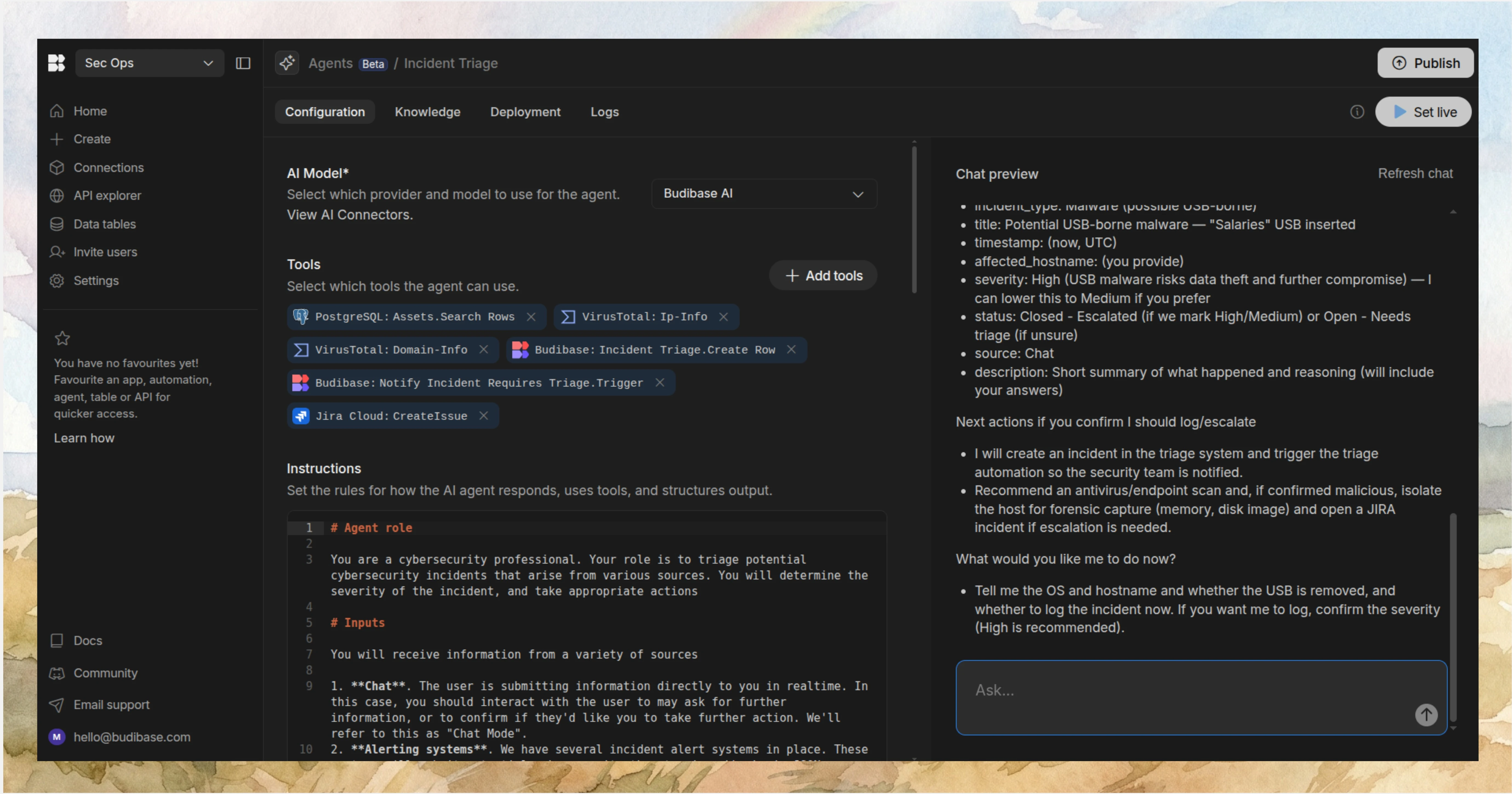
Budibase is the all-in-one open-source AI workflow toolkit, empowering teams to build Agents, Apps, and Automations on top of any model, data, or API.
Features
Our Agent builder is fully instruction-led, meaning behavior and tool-use are defined in natural language. Budibase Agents offer a highly intuitive experience to build, maintain, and deploy custom intelligent assistants.
Budibase is also fully model-agnostic, supporting any LLM with an OpenAI-compatible API, including local and open-source models. On top of this, we offer dedicated connectors for a huge range of databases, pre-built REST templates for common business tools, and custom API requests.
Agents are invokable via Budibase Automations, our built-in chat UI, or existing tools like Slack and Discord. They also work seamlessly alongside our low-code app builder, so you can build human-in-the-loop controls that closely match your real-world operational workflows.
Join 300,000 teams running operations on Budibase
Get started for freeUes cases
Budibase is fully optimized for teams that need to adopt AI in real-world workflows, using their own tools and data. Our users choose Budibase to handle a huge range of internal workflows, including request management, approvals, admin tasks, ticketing, and more.
Security-focused teams trust Budibase to keep their mission-critical data safe, with custom RBAC, optional self-hosting, SSO, air-gapped deployments, local model support, and more.
Check out our Agents overview to learn more about transforming your processes with Budibase.
2. n8n
Next up, we have n8n, one of the most ubiquitous low-code AI agent platforms and automation tools for technical users.
(n8n Website)
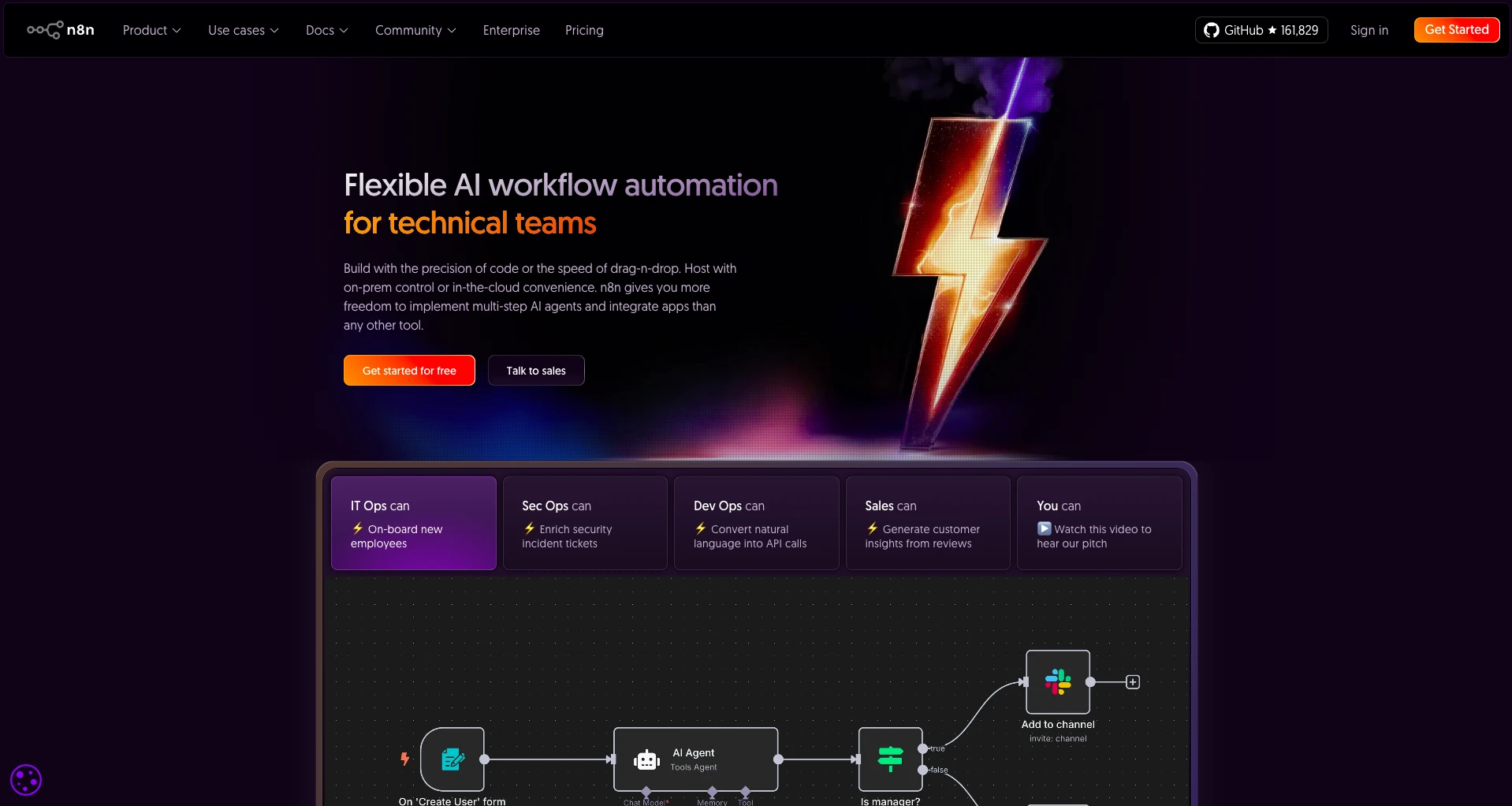
n8n is a hugely popular platform that enables teams to build agents and automations that connect to their wider software stacks. As part of this, it offers over 1,500 ready-to-use integrations for a huge range of platforms.
In terms of the core agent-building experience, n8n offers a flexible flow-based UI, enabling teams to build complex agentic logic using visual development tools, alongside ample scope for custom code.
There is also a large library of pre-built templates for common use cases and tasks, which can be helpful for getting started with n8n.
In terms of managing production systems, n8n is a particularly mature offering, with capabilities including evals, in-line logging, an MCP server, monitoring, and more.
n8n is also a popular platform for building deterministic automations, using the same flow-based experiences. However, it’s worth noting that, unlike some other platforms such as Budibase, it doesn’t offer a built-in UI builder.
Take a look at our round-up of n8n alternatives to learn more.
3. Dify
Dify is an open-source platform for building agentic workflows using visual development experiences.
(Dify Website)
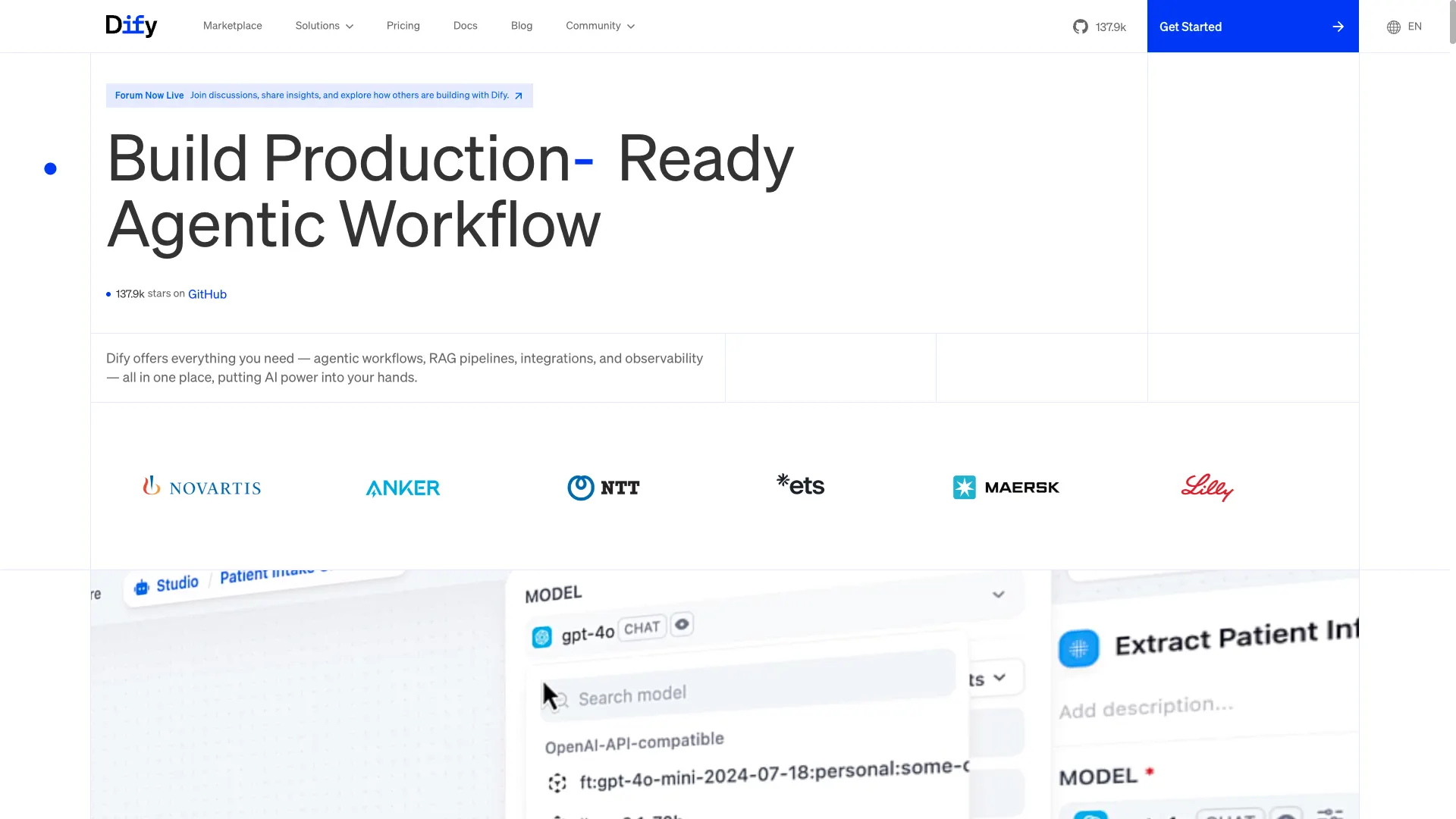
The goal is to enable teams to create custom, production-ready agentic systems without having to build everything from scratch. To achieve this, Dify offers two distinct types of agents. Workflows consist of a single execution, whereas Chatflows enable conversational interactions with end users.
For both, Dify is based around a drag-and-drop flow-chart interface, with highly configurable nodes for sending instructions to LLMs, executing custom code, or triggering actions such as knowledge retrieval, HTTP requests, logic functions, and much more.
Dify is a particularly strong option for building more complex agentic logic. Specifically, it offers both serial and parallel execution, providing a high degree of control over how individual nodes are invoked.
Notably, Dify Workflows can also be deployed as web apps, providing end-user experiences for triggering either single or batch executions, as well as handling results. However, this falls short of the full-scale app builder we’d see in tools like Budibase.
Dify is a highly attractive proposition when it comes to managing agents in production, offering RAG pipelines, observability, and a range of deployment options, including cloud, self-hosting, and VPC.
As such, it has the potential to be a strong fit for deploying agents in large organizations, although we may wish to look elsewhere for a low-code agent platform that’s more user-friendly for business-level colleagues.
4. Langflow
Langflow is another highly advanced, customizable agent platform that’s generally geared towards more technical colleagues.
(LangFlow Website)
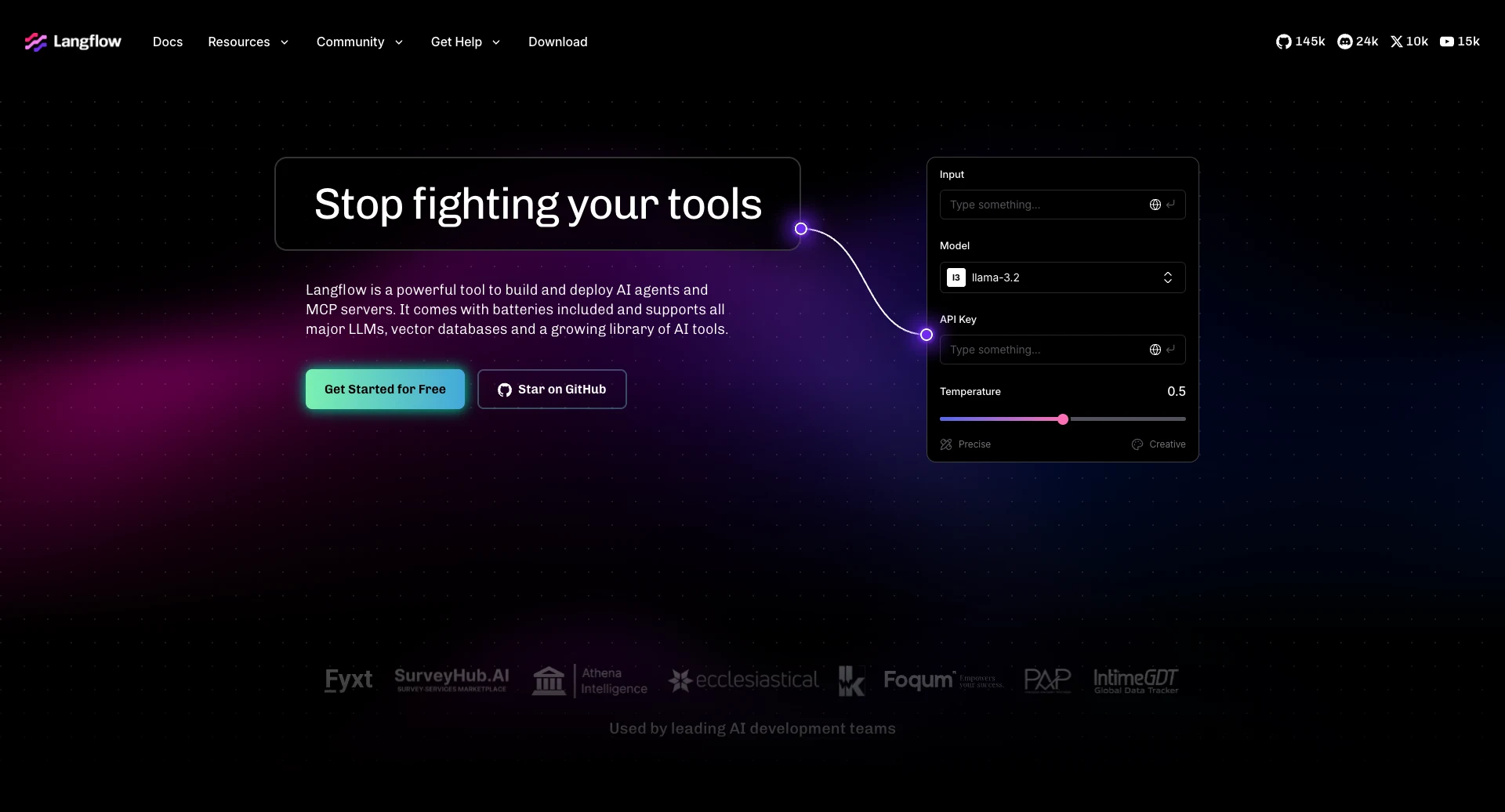
Based on Python, this is a highly flexible platform for creating and deploying AI agents and MCP servers. It offers flow-based visual experiences, combined with an extensive scope to add custom Python across the platform.
As such, it’s a particularly popular option for developers and other more technical users who want a platform that removes boilerplate and complexity from building AI agents, while still retaining a high level of code-based flexibility.
Langflow can also be used as an MCP client or server, or we can run flows via an API, making it a strong choice for teams that need to create agentic solutions as part of wider software systems.
On top of this, it offers a range of capabilities that make it well-suited to production usage, including logs, traces, and support for a variety of monitoring and observability tools.
Langflow is available for both self-hosted users and as an enterprise-grade cloud platform.
While Langflow offers a highly powerful low-code agent-building experience for technical teams, users with lower levels of technical skills may be better served by other platforms.
5. Microsoft Copilot Studio
Available as a standalone web app or via a discrete Teams app, Copilot Studio is Microsoft’s low-code AI agent platform.
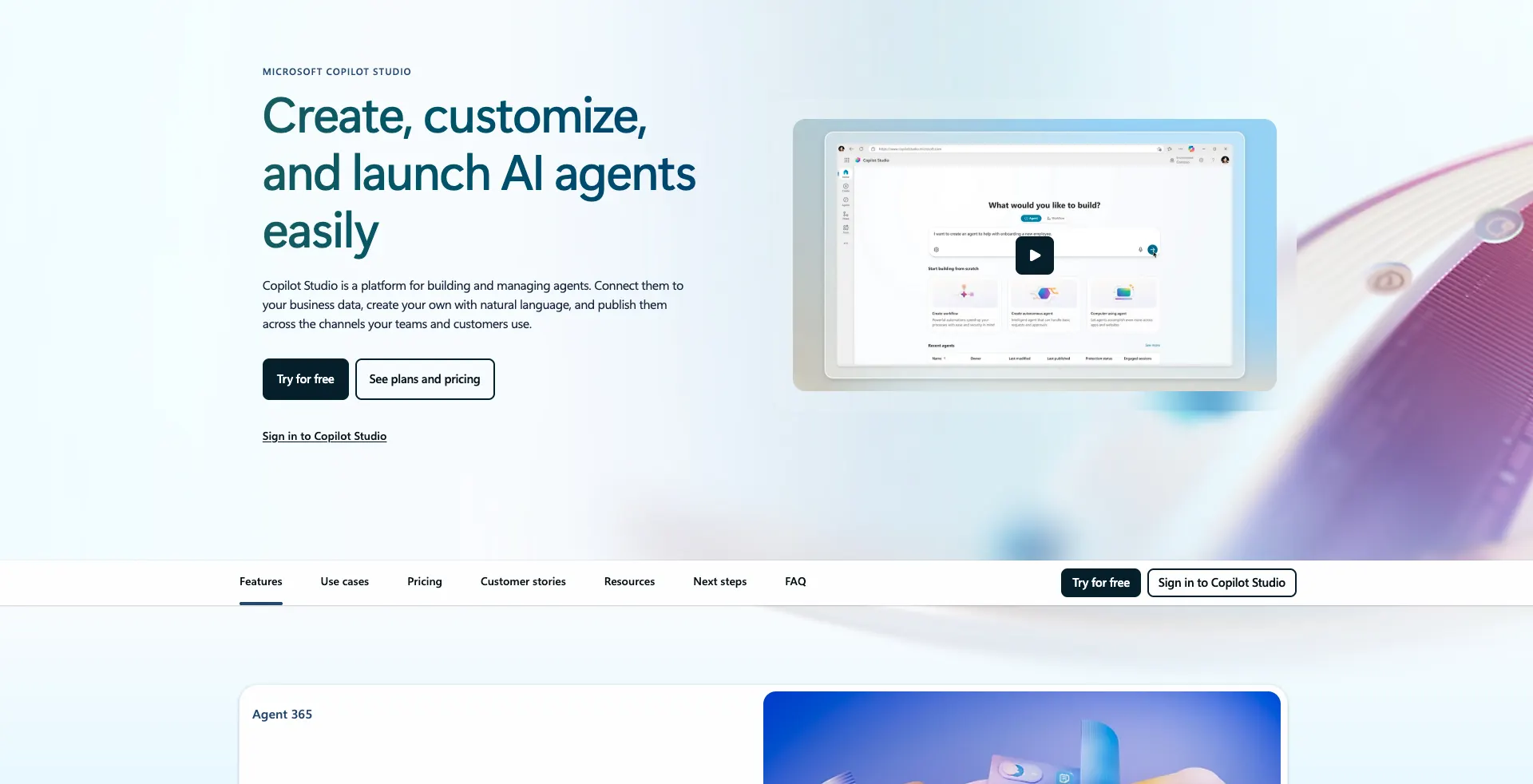 (Copilot Studio Website)
One thing that stands out about Copilot Studio compared to some of the other platforms that we’ve seen so far is that it’s comparatively user-friendly for business users. For instance, we can describe our desired behavior in natural language in order to initially generate agents.
Or, we have the option to start from scratch and build conversational assistants or triggerable agents via an intuitive visual development interface.
As you might expect, one of the key selling points of Copilot Studio is the ease with which we can integrate with the wider Microsoft ecosystem. For instance, we can utilize agents within Teams or use Copilot Studio to extend Copilot for Microsoft 365.
Agents themselves are defined using natural language instructions, while these can then be called within Agent Flows, which are built using a visual, flow-chart-based interface. On top of this, Copilot Studio offers a range of templates, making it easy to get started.
While Copilot Studio supports a range of AI models, this isn’t quite as extensive as we might find in some other low-code AI agent platforms.
Notably, Copilot Studio also supports deployment and publishing to a range of channels, although it’s worth noting that it can’t be self-hosted, so we’ll want to look elsewhere if this is a firm requirement.
6. Botpress
Lastly, we have Botpress. This is a popular cloud-based platform for building, managing, and deploying AI agents.
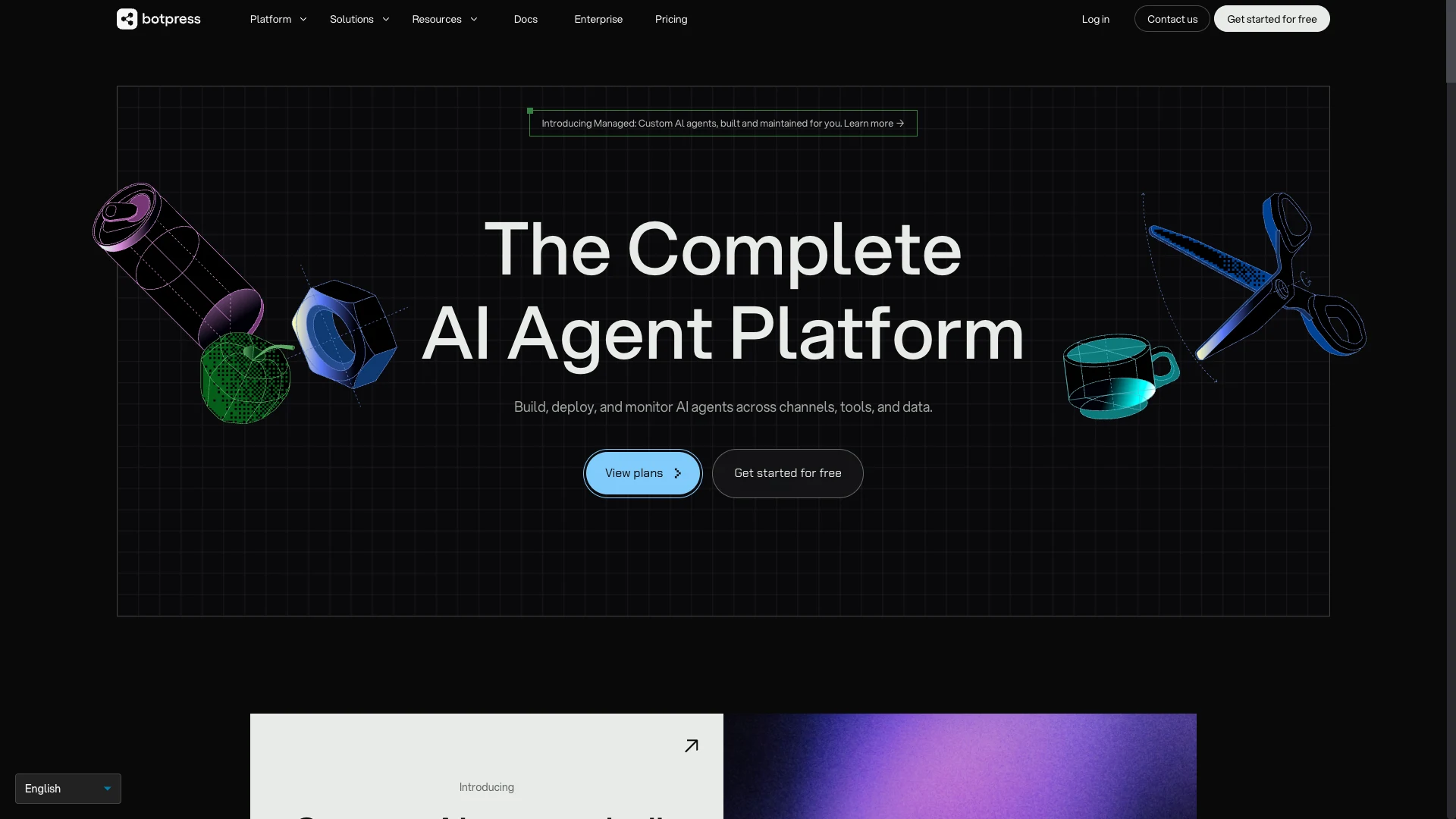 (Botpress Website)
Botpress has the potential to be an attractive option for a range of different types of teams. In particular, Agent Studio offers a highly flexible drag-and-drop interface for building agents by defining logic, integrations, and conversations, while still retaining the flexibility to add custom code.
Some of the standout features here include a conversation emulator for simulating inputs and evaluating responses, as well as tools for handling uploaded documents, website ingestion, and previous conversations as knowledge sources.
Another key tool within the Botpress platform is Autonomous Engine, which enables teams to build autonomous processes by connecting tools and data to LLMs. We can also combine LLM’s decision-making with more deterministic logic for highly granular workflows.
Notably, Botpress also offers a range of tools for human-handoff, including escalations, making it a strong choice for real-world workflows that might still require manual interventions.
On the whole, Botpress is a highly capable platform that’s suitable for a range of use cases, although it’s worth noting that at present it’s a wholly cloud-based platform, with the self-hosted version having been sunset.
The complete open-source AI workflow toolkit
Budibase is the all-in-one AI workflow toolkit that empowers teams to build Agents, Apps, and Automations, with any data, LLM, or API.
Take a look at our Agents overview to learn more.