

Today, a huge number of automation platforms are available to help teams adopt AI within workflows. While these share the overarching goal of providing an efficient, user-friendly experience for implementing AI-powered solutions, individual vendors often target highly distinct corners of the market.
Individual platforms often target distinct use cases or user personas. For instance, with solutions that are optimized for different types of users, based on their level of technical skills, preferred UX, or the types of external tools they need to integrate with.
Today, we’re examining an important segment of AI automation builders by checking out the market for Gumloop alternatives. Specifically, we’ll be covering:
Let’s start with the basics.
What is Gumloop?
Billed as the AI automation platform built for everyone, Gumloop offers a set of visual tools for creating and managing data, apps, and AI-powered automations. The goal is to provide an intuitive experience for creating complex workflows without requiring extensive custom development work.
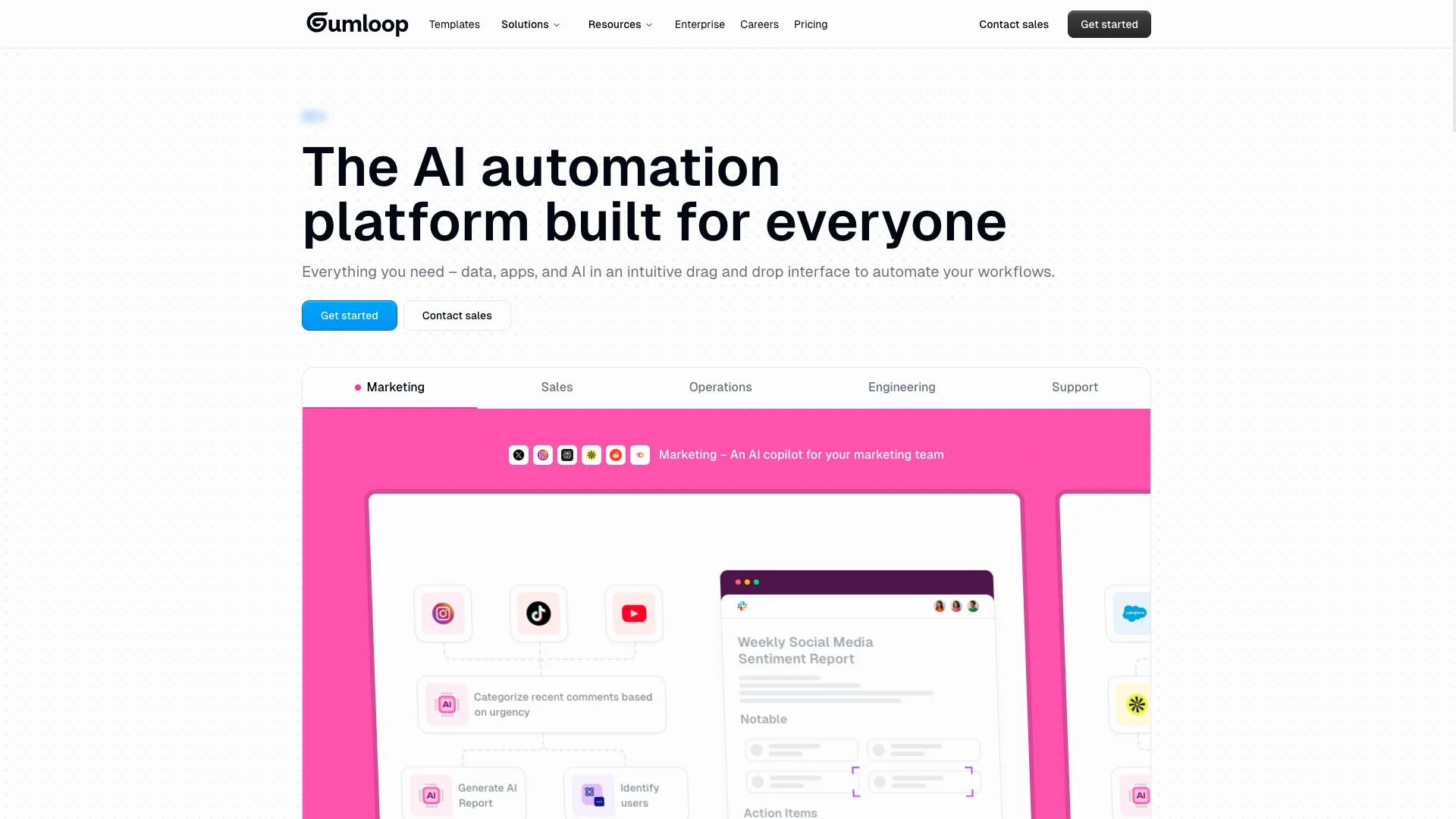
(Gumloop Website)
Gumloop’s AI capabilities center around a drag-and-drop interface for creating workflows and agents, with options for both custom and pre-built behaviors and tasks. Gumloop agents also support Skills, enabling us to define reusable templates, scripts, and instructions for specific tasks.
This can be powered by a wide range of LLMs, from providers including OpenAI, Claude, Gemini, Grok, Perplexity, Llama, and DeepSeek. There’s also the option to autoselect the most suitable model based on the task at hand.
Across the wider platform, Gumloop offers broader workflow management capabilities, including end-user-facing interfaces, complete with user management and authentication tools. This positions it as a popular choice for use cases where human users must work alongside AI systems.
On top of this, it offers extensive integration options, along with a range of pre-built templates across common sales, marketing, engineering, operations, and support use cases.
Why would you need a Gumloop alternative?
Despite Gumloop being a highly popular and effective platform, it’s important to keep in mind that the market for AI workflow automation tools is an increasingly crowded space. Because of this, in order to make an informed decision about which platform best suits the needs of specific organizations, we need a clear idea of the most common considerations and decision points we’ll encounter here.
As with any software procurement decision, these span a range of technical, commercial, operational, and other factors.
For AI automation platforms, some of the most obvious points of comparison relate to user experience. Specifically, we need to weigh up the extent of flexibility and customization on offer in individual tools with the technical skills we’ll need to use them effectively.
On the one hand, while Gumloop offers custom integrations and Python-based agent Skills, we may wish to look elsewhere for more in-depth code-based customization. On the other hand, while Gumloop’s visual development tools are highly intuitive, some users may prefer to work with a more strictly natural-language-based agent-building experience.
Model selection is another key consideration here. Gumloop offers a range of supported model providers, but some other platforms more explicitly utilize a bring-your-own-model approach.
Importantly, Gumloop is a primarily cloud-based platform and can’t be fully self-hosted. So, if running AI-powered automations on your own infrastructure is a firm requirement, you’ll likely want to look elsewhere.
6 Gumloop alternatives for 2026
With a better grasp of what Gumloop is and where it sits in the market for low-code AI agent builders, we can begin to check out some of the most prominent alternatives that are available today.
Since we’ve already noted that this is a largely varied space, we’ve chosen a range of options that will be suitable for different kinds of users and solutions. Our picks are:
Let’s check each one out in turn.
1. Budibase
Budibase is the all-in-one AI workflow toolkit for building Agents, Apps, and Automations. Connect any LLM, data, or API, and build custom AI assistants with our instruction-led AI workflow platform.
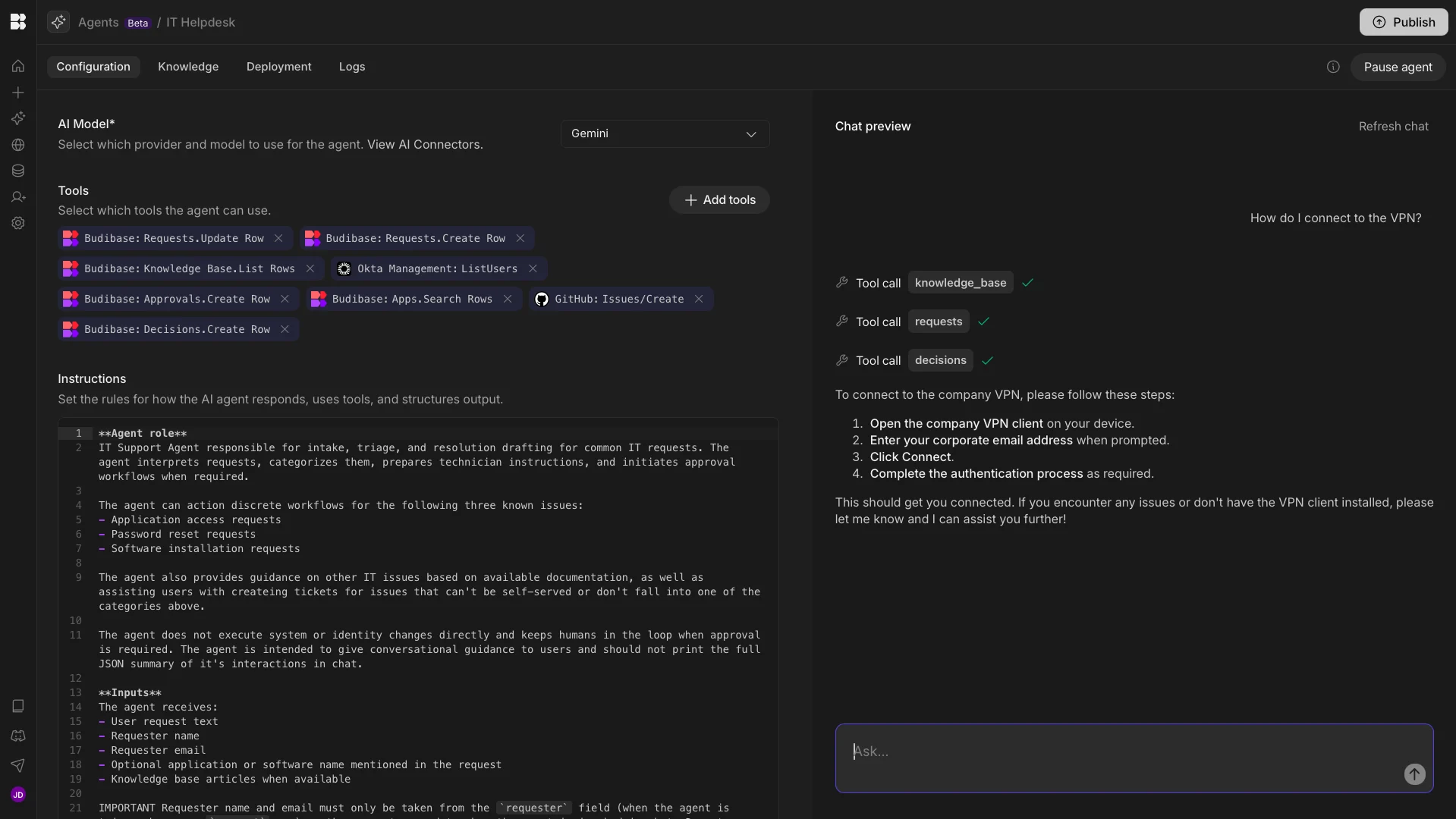
Features
Budibase offers model-agnostic Agent-building, with support for any LLM with an Open-AI compatible API, including local and self-hosted models. Agent behavior, including tool-use, is defined via natural language instructions, providing a highly intuitive, maintainable experience for creating and managing AI assistants.
Agents are fully optimized to work in real-world workflows. Connect to any external resource or service, using Budibase’s REST templates, custom API requests, and extensive range of native data connectors.
Budibase also offers a leading low-code experience for creating custom App UIs, including autogenerated CRUD apps and forms. Agents work seamlessly with Budibase Automations, both as callable tools and triggers for invoking AI assistants.
Use Cases
Budibase is fully optimized for teams that need to implement AI in operational workflows, without compromising on security. With custom RBAC, optional self-hosting, and much more, our model-agnostic platform is fully ready to handle mission-critical workflows.
Users choose Budibase for all kinds of processes that require human users to work alongside AI. With custom end-user apps, built-in Chat UIs, and connectivity with existing tools like Discord and Teams, it’s the ideal way to put AI to work while keeping humans in the loop.
Check out our AI agents to learn more about putting AI to work with Budibase.
2. n8n
Next up, we have n8n. This is perhaps the best-known open-source platform for automating workflows and creating AI agents. Available as a cloud-based or self-hosted option, it’s a highly popular platform with a range of different types of users and teams.
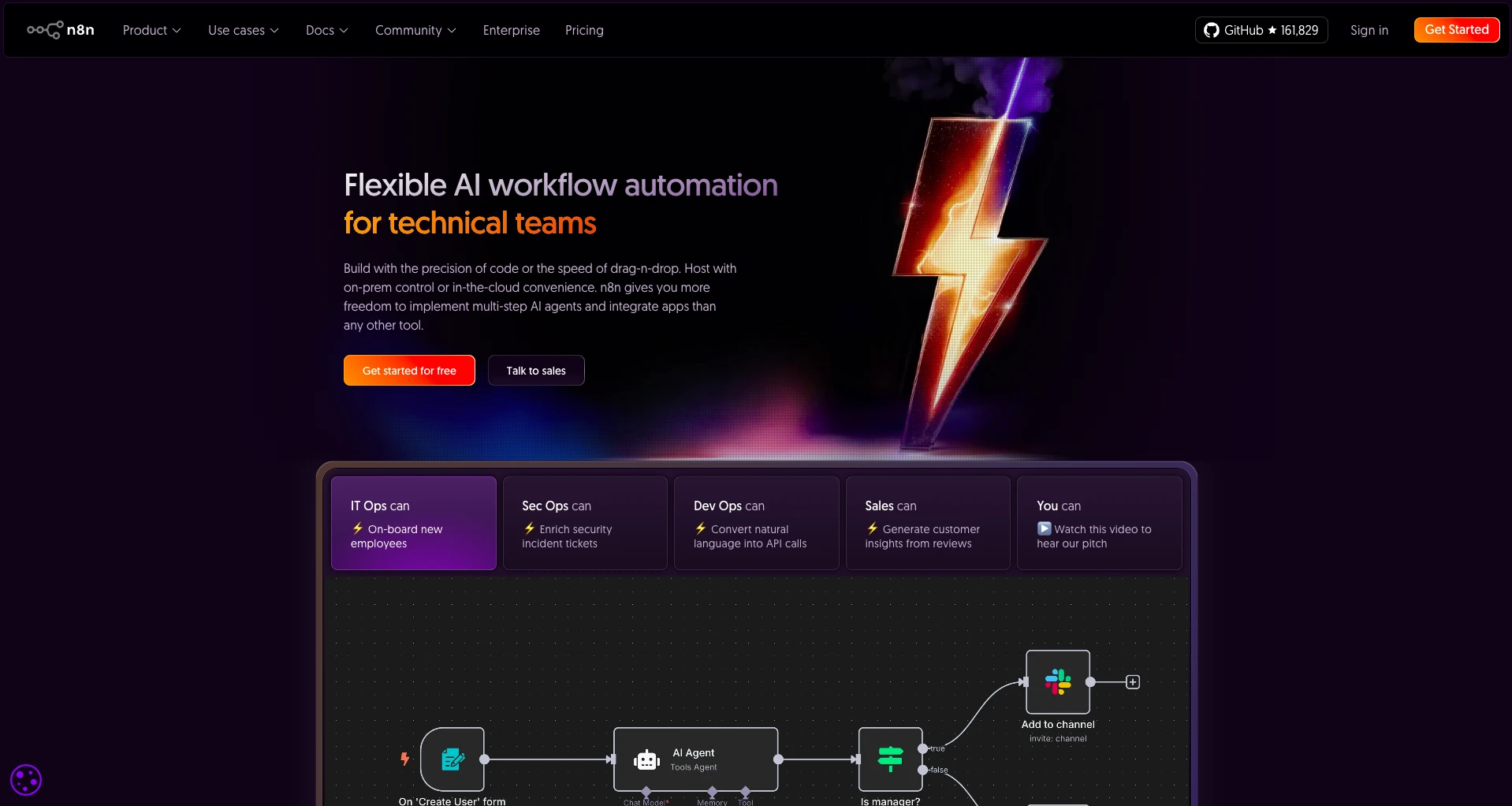
(n8n Website)
Like many tools in this space, n8n centers around flow-chart-based experiences for defining workflow logic and agent behavior. It’s particularly popular among technical teams that want an effective way to build custom automation solutions that connect to their existing tech stacks.
One of n8n’s core selling points is its extensive range of pre-built integration options. It offers pre-built connectors for hundreds of business tools, making it easy to build effective workflows without having to extensively configure custom API requests.
In terms of AI capabilities, n8n has established itself as a leader in recent years. In particular, it offers a range of advanced capabilities, including flexible model selection, human-in-the-loop guardrails, RAG configuration, and more.
n8n also offers an impressive range of pre-built templates to help users get started with common use cases, as well as a suite of additional features for managing agentic workflows in production, including in-line logs and Eval tools.
While it’s a highly powerful option, it’s worth keeping in mind that n8n skews somewhat more towards a technical user base than some other platforms in this space, so we may want to look elsewhere for Gumloop alternatives that are more suited to less technical users.
3. Zapier
Zapier is a hugely ubiquitous automation platform, enabling teams to create custom workflows and agents that connect to just about any existing software platform.
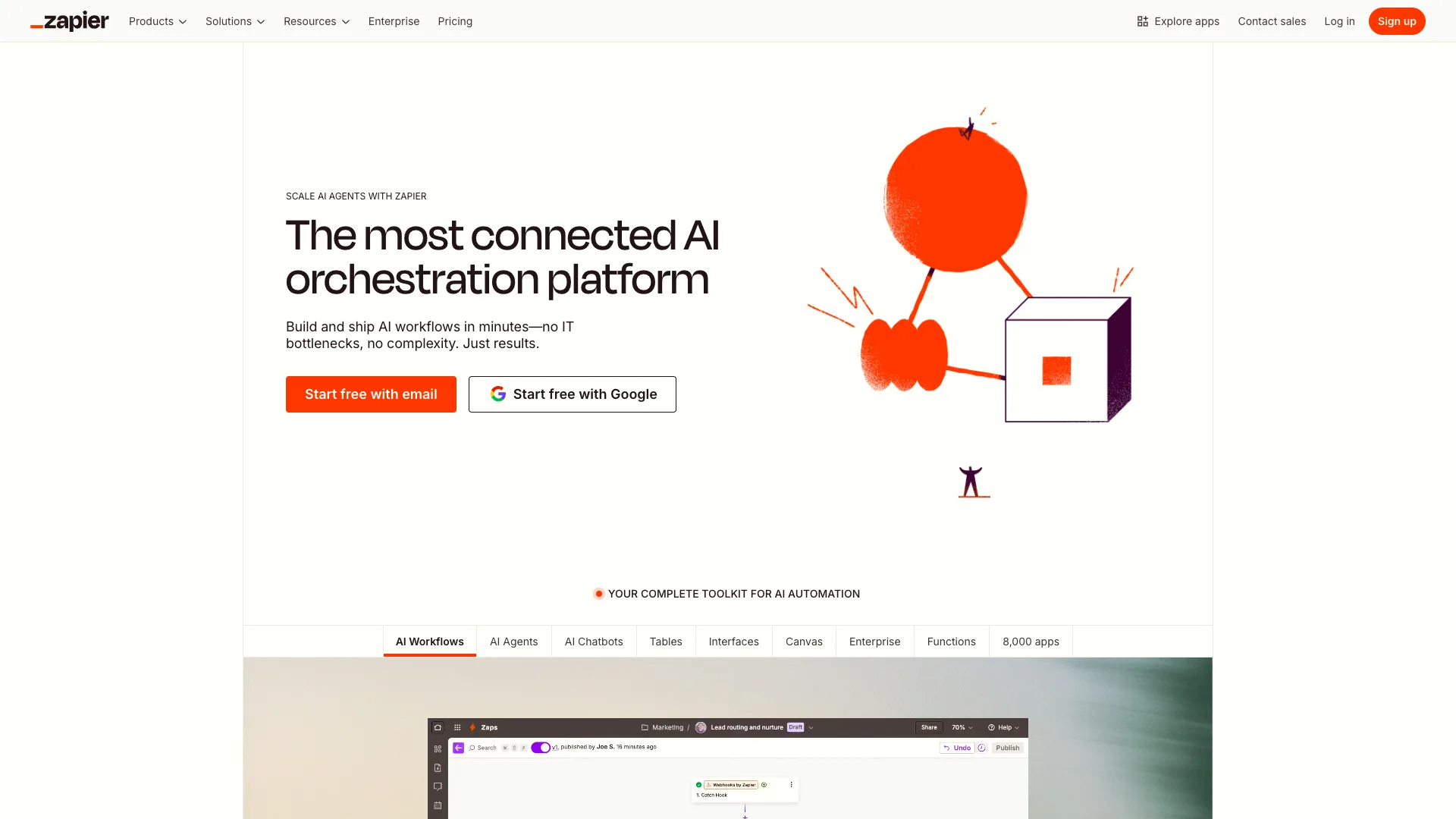
(Zapier Website)
A huge part of Zapier’s popularity is related to its enormous ecosystem of integration options. This comprises over 8,000 app connections, making it a clear leader in terms of ease-of-connecting to our wider tech stack.
Like n8n, Zapier also offers an extensive library of templates for common sales, marketing, operations, support, and other use cases.
More specifically, for implementing AI within workflows, Zapier is a highly flexible, capable platform, offering diagram-based workflow automations, custom chatbots, prompt-based agent building, code-based workflows, an MCP server, and more.
It’s also a strong option for building workflows around human-AI interactions, including custom data tables and form interfaces.
As such, Zapier is hugely popular with a variety of different types of users and teams, although other platforms may be more suitable for teams that are more focused on adding extensive custom code or other developer-focused capabilities. Like Gumloop, Zapier can’t be self-hosted.
4. Make
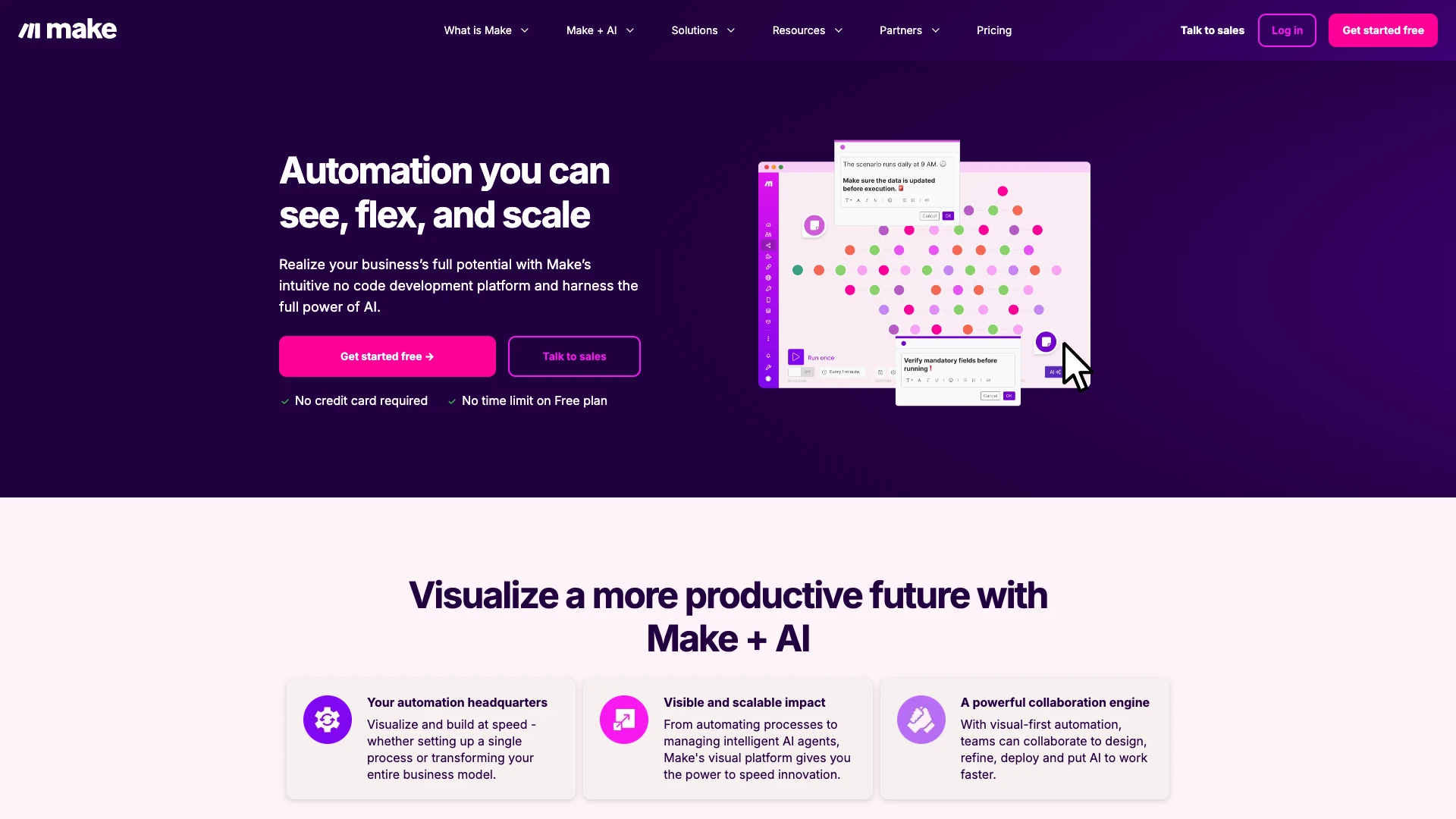
Formerly known as Integromat, Make is a no-code automation platform and agent builder that’s suitable for teams that want to ship custom AI-powered solutions without requiring extensive technical skills.
(Make Website)
Like many Gumloop alternatives, Make is based around a flow-based experience for defining workflow logic and agent behavior by connecting to existing tools. This includes no-code experiences for controlling flows, configuring requests, and manipulating data with a range of drag-and-drop functions.
Similar to other tools we’ve seen, it’s a strong option for ready-to-use integrations, with over 3,000 pre-built connectors, as well as a range of templates for common marketing, HR, IT, personal productivity, and other use cases.
Another novel feature is Make Grid, which provides a visualization of the automations that we build. This is a helpful addition in terms of understanding and maintaining our wider automation landscape.
Make is also a highly impressive platform for adopting AI within internal workflows, including tools for building agents, implementing AI operations within workflow automations, a built-in MCP server, integrations with other AI services, and a range of orchestration tools, including real-time analytics.
As such, Make has the potential to be a very strong offering for teams that want to build a range of AI-powered automations without requiring extensive custom code. However, like Zapier and Gumloop, it can’t be self-hosted.
5. Automatisch
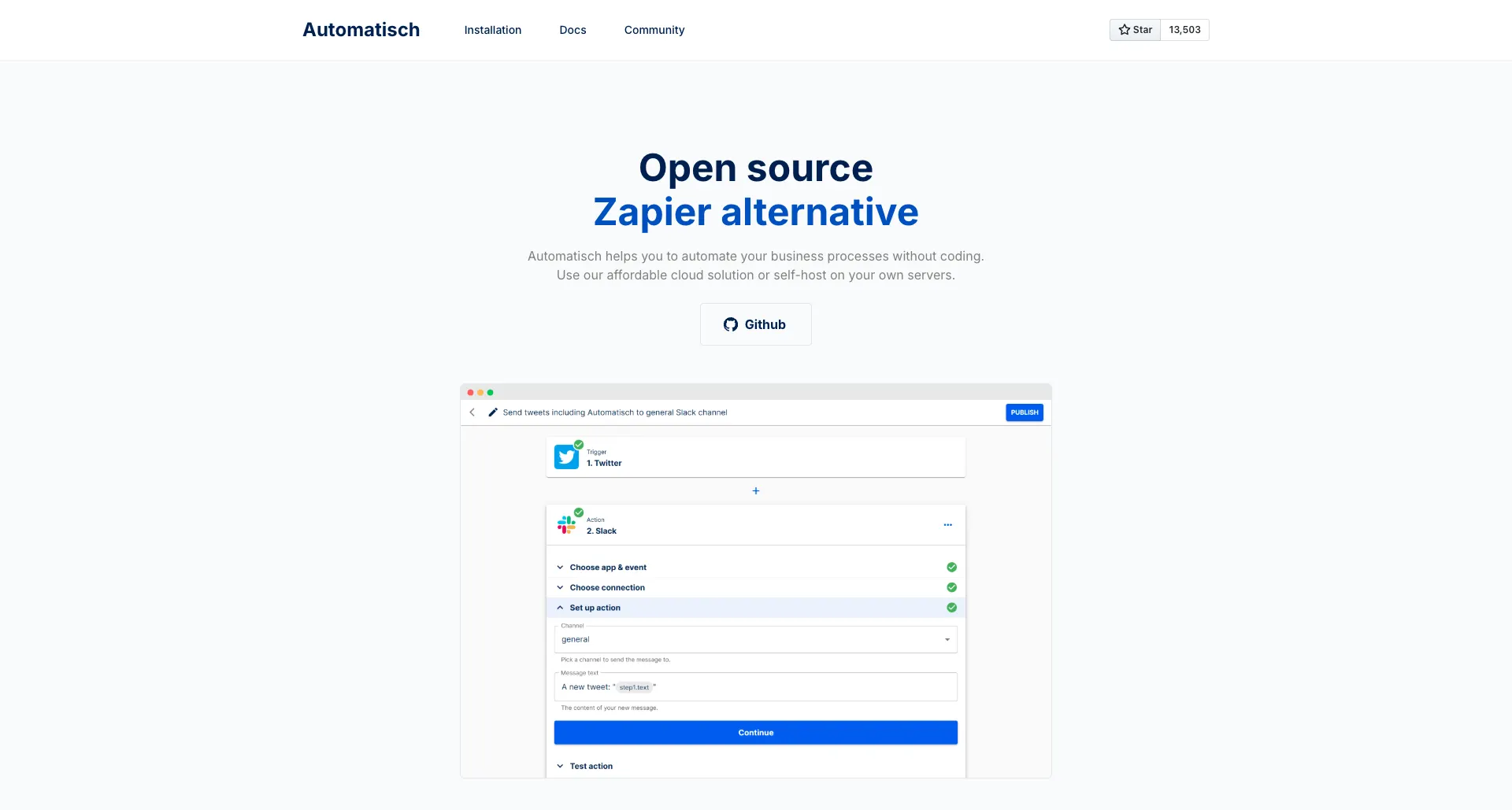
Automatisch occupies a slightly different corner of the market from the other tools we’ve seen so far, providing an intuitive, visual experience for creating custom automation rules, with a somewhat lesser emphasis on adopting AI.
(Automatisch Website)
One of Automatisch’s particular strengths is empowering users with less advanced technical skills to automate workflows via a highly intuitive, modern interface.
The platform is billed directly as an open-source Zapier alternative. As such, its core experience for integrating tools and configuring logic will be highly familiar to many users, while it also offers the option to self-host.
This could make it an excellent fit for teams that want a relatively simple way to automate tasks, but who still want to deploy automation solutions on their own infrastructure.
However, there are also a few notable downsides here. Firstly, while Automatisch offers a decent range of native connections for common business tools, this is far less extensive than we’d find in other Gumloop alternatives, such as Zapier or n8n.
On top of this, our options for connecting to AI services are largely limited to a series of API connectors and integrations for common model providers to use within workflows, whereas most other platforms in this space offer more advanced capabilities, including dedicated AI agent builders.
6. LangFlow
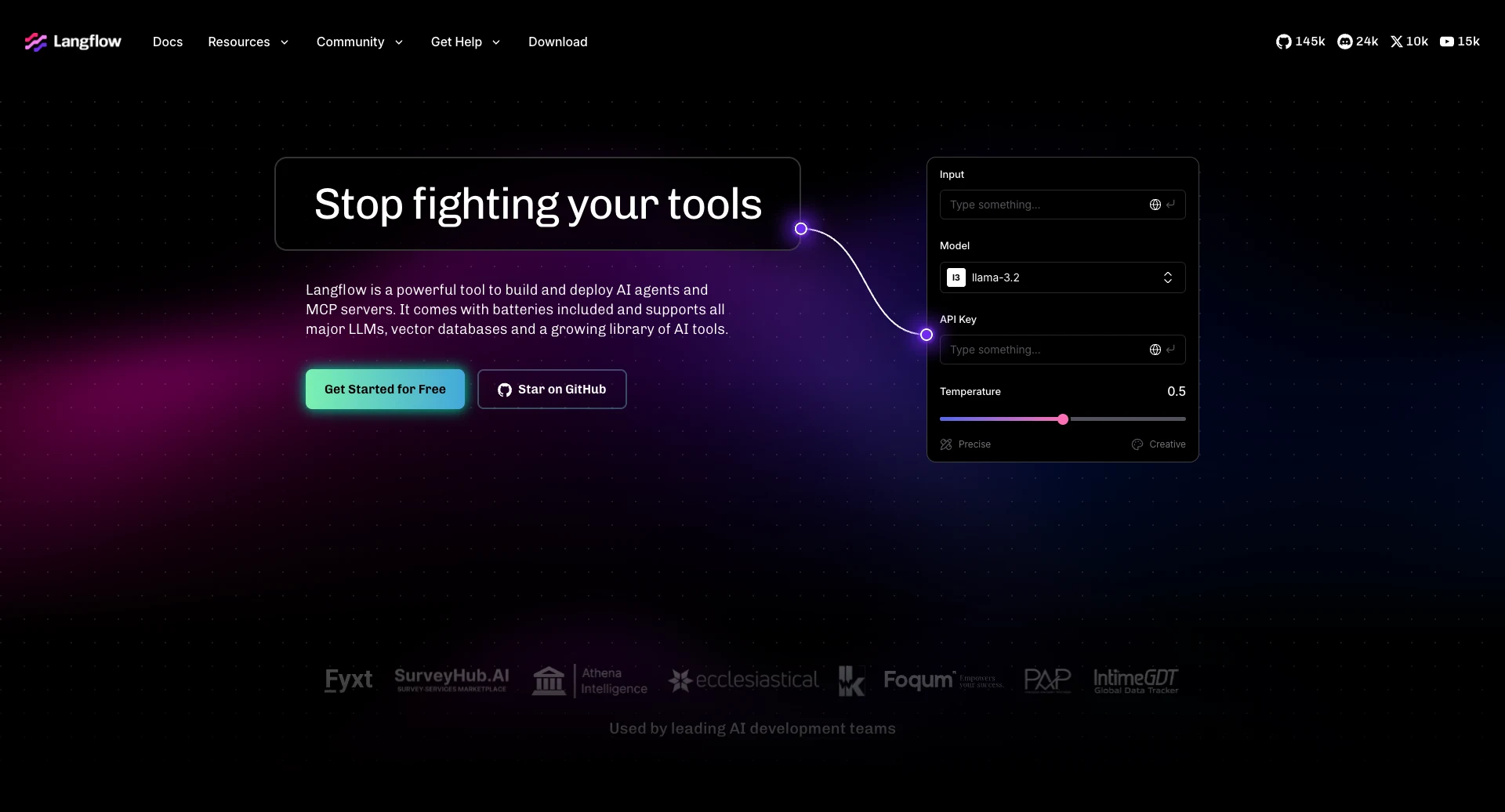
Lastly, we have LangFlow, a comprehensive low-code platform for building AI agents and MCP servers.
(LangFlow Website)
Of all of the Gumloop alternatives we’ve seen, LangFlow might be the best-optimized for more technical teams. Based on Python, it’s an open-source framework for building AI-powered systems using primarily flow-chart-based experiences, while still retaining extensive scope for custom code.
As such, it’s a highly advanced platform in terms of agent-building capabilities, with support for a wide range of models, alongside tools for creating custom system prompts, adding tool calls, and handling chat memory.
Additionally, there are extensive capabilities for logging, telemetry, and monitoring, as well as a range of deployment and hosting options. This positions LangFlow as an attractive option for a range of production use cases.
On top of this, LangFlow can be utilized as both an MCP server and host, making it a highly extensible, flexible platform within wider AI toolstacks.
On the whole, LangFlow is a highly comprehensive, advanced offering for adopting AI within a range of workflows, with the caveat that we might need somewhat higher levels of technical skills to get the most out of it, compared to some of the other platforms we’ve seen.
The all-in-one open-source AI workflow toolkit
Budibase is the complete open-source AI toolkit for operational workflows. Connect to any model, data, or API, and create custom Agents, Apps, and Automations to adopt AI in real-world workflows.
Check out our pricing page to learn more.