

Incident management is one of the most critical practices under the umbrella of ITSM and service management more generally.
This concerns how we identify, analyze, and respond to incidents, such as service interruptions, outages, data loss, physical damage, hardware crashes, unauthorized access, and others.
The goal is to prevent disruptions, minimize costs and risks, and prevent similar incidents from occurring in the future.
Of course, like almost all business processes, incident management has been massively impacted by the rise of artificial intelligence. Today, we’re diving deep into this topic by checking out the market for AI incident management tools.
Specifically, we’ll be covering:
- What are AI incident management tools?
- Why implement AI in incident management workflows
- What to look for in AI incident management software
- 6 AI incident management tools for 2026
Let’s start with the basics.
What are AI incident management tools?
As the name suggests, AI incident management tools are software systems that enable us to leverage AI within incident management workflows.
As you might expect, this can come in a few different forms. That is, there are a few distinct ways we might want to utilize AI for incident management.
One helpful way to think about this is in terms of the key stages of the incident management process.
As we mentioned earlier, the first of these is identification. The most obvious way that AI can assist us here is with monitoring. Specifically, there are a range of tools on the market to identify incidents based on data anomalies.
Similarly, within incident reporting workflows, AI can be highly beneficial in the form of natural language processing, helping us to perform a range of tasks, including extracting key information from long-form submissions or providing summaries to human service agents.
To learn more, check out our guide to AI incident triage.
Of course, many tools also help us to leverage AI within incident responses. In particular, in recent years, the rise of agentic AI has led to substantial changes to the way IT teams automate incident responses.
Specifically, a growing number of teams are implementing agentic systems, capable of independently assessing context and taking actions in response to reported incidents, including both analysis and resolution actions.
For instance, based on previous resolutions or defined playbooks.
Why implement AI in incident management workflows
It’s also helpful to think about some of the core benefits of AI incident management.
Naturally, a huge factor behind the growing adoption here is efficiency savings. That is, AI presents a massive opportunity to reduce the manual administrative workloads required for managing incidents.
For example, AI tools may be able to handle relatively minor or routine incidents more or less autonomously, as well as carrying out crucial tasks for responding to more serious incidents, such as analysis and information-gathering.
As well as reducing the resources incurred by incident management, this is also a powerful way to improve service quality. In particular, AI tools can lead to much faster responses and resolutions, helping to minimize the costs, risks, and service interruptions associated with IT incidents.
Additionally, AI-powered incident management tools offer an effective solution for gaining better oversight of our IT estate, including through proactive monitoring and streamlined incident reporting processes.
This can often mean we’re able to identify incidents earlier, helping both to prevent their occurrence and minimize the impact of incidents when they do occur.
As such, AI incident management tools are a key aspect of how modern IT teams ensure that their service portfolios and ecosystems remain secure, reliable, and effective.
What to look for in AI incident management software
Before we start looking at some of our specific options from across the market for AI incident management software, it’s also important to have a grasp of the key considerations and decision points we’re likely to encounter when assessing individual platforms.
Incident management is obviously a highly sensitive internal process, as well as being mission-critical, in the sense of helping to maintain continuity and security within our IT ecosystem and across the wider organization.
As such, we might have heightened requirements around security, data management, and other factors.
In the specific case of AI incident management, one critical element to this is how and where our data is stored, processed, and consumed by LLMs.
For instance, many teams in large organizations have strong preferences for AI automation tools that enable them to handle entire processes within their own environment, including support for on-premises LLMs.
Additionally, effective incident management typically requires extensive integrations with a wide variety of tools across the entire IT estate, including infrastructure, end-user tools, MDM platforms, ITSM tools, SaaS platforms, user management, knowledge sources, and much more.
As such, when assessing individual platforms, we’ll need to be confident that they can securely and reliably integrate with our required tooling.
Lastly, we’ll want to pay close attention to the scope for customization within individual AI incident management tools.
A key aspect to this is the extent to which we can define our own workflows, including defining sequences of steps for resolving specific incidents, escalation rules, and configuring how and when various tools and functions can be triggered by AI-powered systems.
Similarly, the experiences for defining this kind of logic may differ from one platform to the next. For instance, some platforms can offer extensive scope for defining logic via code, while others prioritize visual development experiences.
6 AI incident management tools for 2026
Having covered what AI incident management tools are, where they can offer value, and some of the key decision points we’ll want to consider, we can next move on to checking out some of the most prominent solutions for implementing AI in incident management workflows.
As we do so, it’s important to be aware that this is a relatively diverse space, with a few distinct types of platforms that can be used for AI incident management.
Some of the key categories we’ll need to be aware of include AI-powered incident monitoring solutions, wider ITSM platforms with AI capabilities that can be leveraged for managing incidents, and low-code platforms that enable us to leverage AI in a variety of business processes, including incident management.
With that in mind, we’ve chosen a diverse set of options to represent what’s available across this space. Our specific picks are:
Let’s check each one out in turn.
1. Budibase
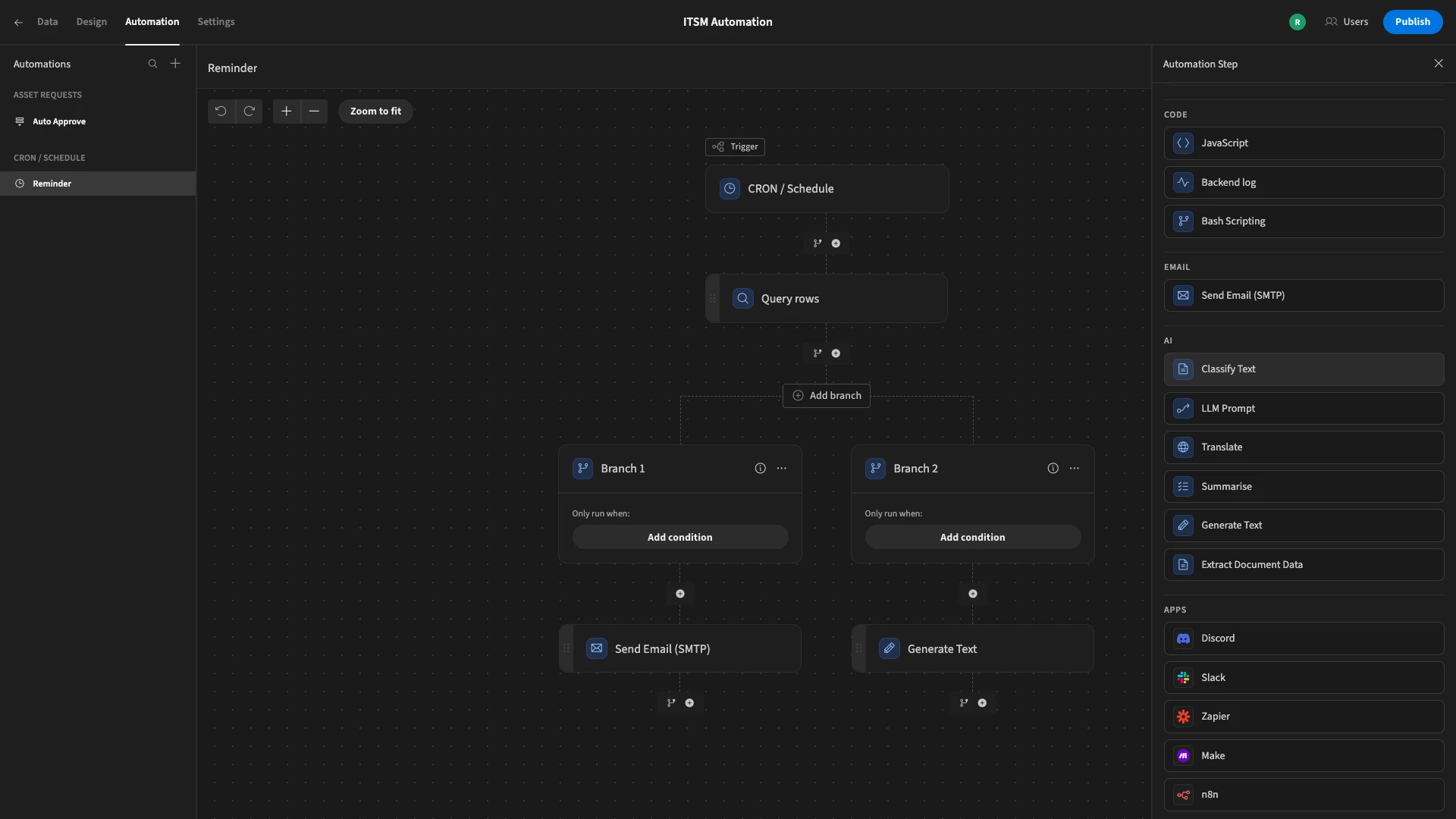
Budibase is the open-source, low-code platform that empowers IT teams to turn data into action. With extensive data connectivity, autogenerated UIs, and powerful AI-driven automations, our users trust Budibase for a range of incident management use cases.
Features
Budibase offers dedicated connectors for a huge range of RDBMSs, NoSQL tools, APIs, and more, making it the perfect solution for building internal tools and AI-powered workflow automations on top of all kinds of enterprise data.
Once you’ve connected your data, it’s easy to build professional interfaces with our intuitive low-code editor, including autogenerated screens for building forms and CRUD apps on top of SQL databases.
Budibase is also the ideal solution for creating powerful, AI-driven workflow logic. Our visual automation editor features a range of pre-built triggers and actions, including predefined LLM operations and custom prompt logic.
Use cases
Budibase is fully optimized for the needs of busy IT teams. In particular, our users trust Budibase to handle a wide range of tasks, including incident reporting, approval workflows, administrative processes, data management, ticketing, and more.
With highly customizable RBAC, Budibase is the ideal platform for managing mission-critical workflows securely, granting users only the exact permissions they need to perform their own responsibilities.
Additionally, we offer optional self-hosting, helping to enable security-conscious teams to retain their data within their own environments.
Take a look at our features overview to learn more.
2. Incident.io
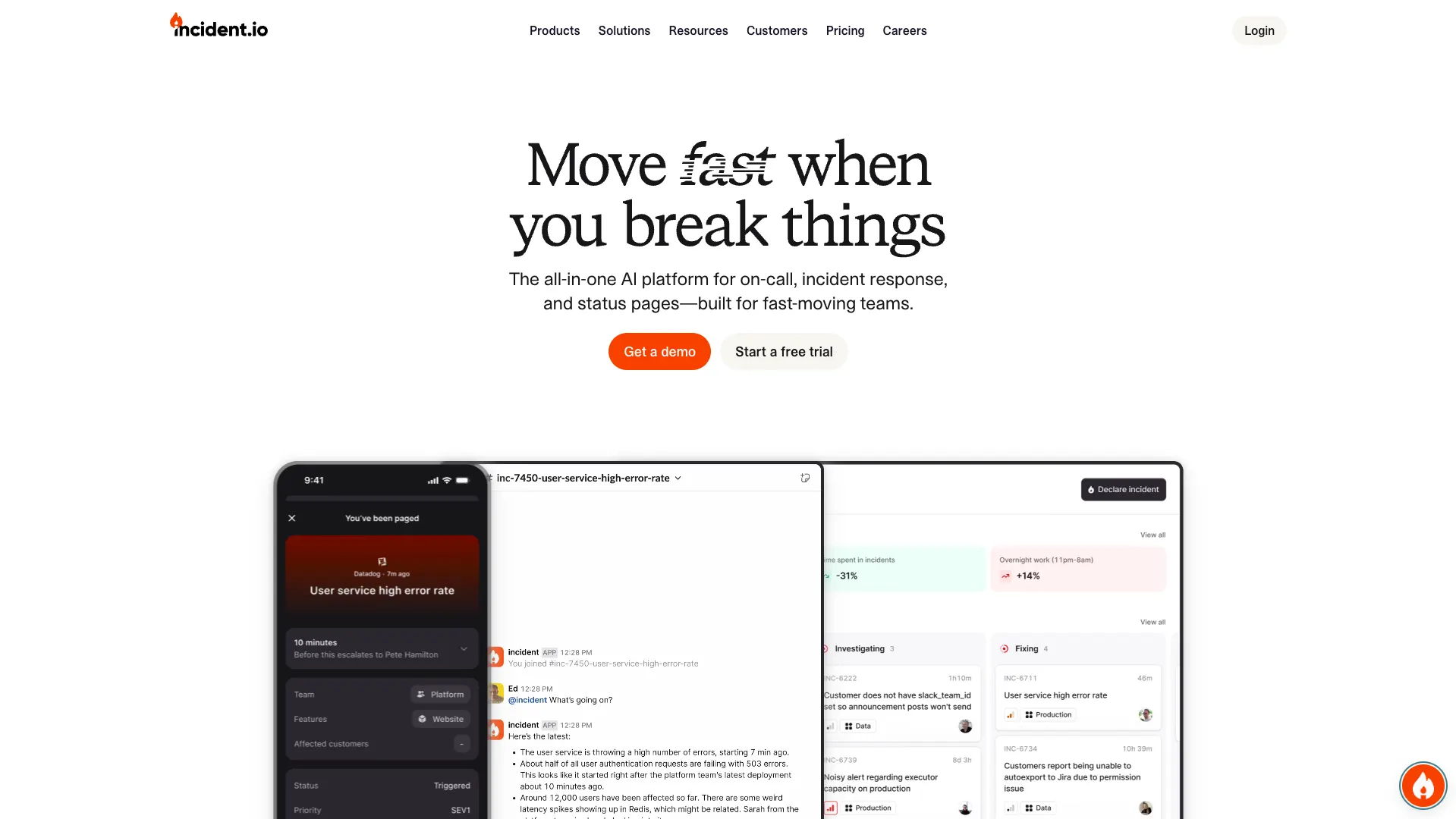
Next up, we have Incident.io. This is an all-in-one, AI-powered platform for managing on-call scheduling, incident responses, status pages, and more, providing extensive capabilities for implementing AI across the whole of the incident lifecycle.
(Incident.io Website)
This centers around a suite of tools that aim to expedite incident responses. For instance, Incident.io’s on-call capabilities offer a range of features for creating schedules and routing alerts to relevant teams and users.
It’s also a highly impressive platform in terms of automating incident responses. This includes several features for responding to both manually reported incidents and automated alerts, with visual workflows, custom fields, extensive integration options, and more.
In terms of more specific AI capabilities, Incident.io provides features for incident triage, summarization, and alert analysis, offering a powerful solution for cutting manual admin tasks within incident management workflows.
On top of this, it offers real-time note-taking alongside a natural language assistant for asking questions, drafting comms, logging follow-up actions, and more.
It also offers a dedicated AI-powered SRE, capable of drafting PRs, surfacing relevant previous incidents, and suggesting next steps.
As such, Incident.io has the potential to be a highly effective AI incident management platform, especially for engineering-heavy IT teams.
3. ServiceNow
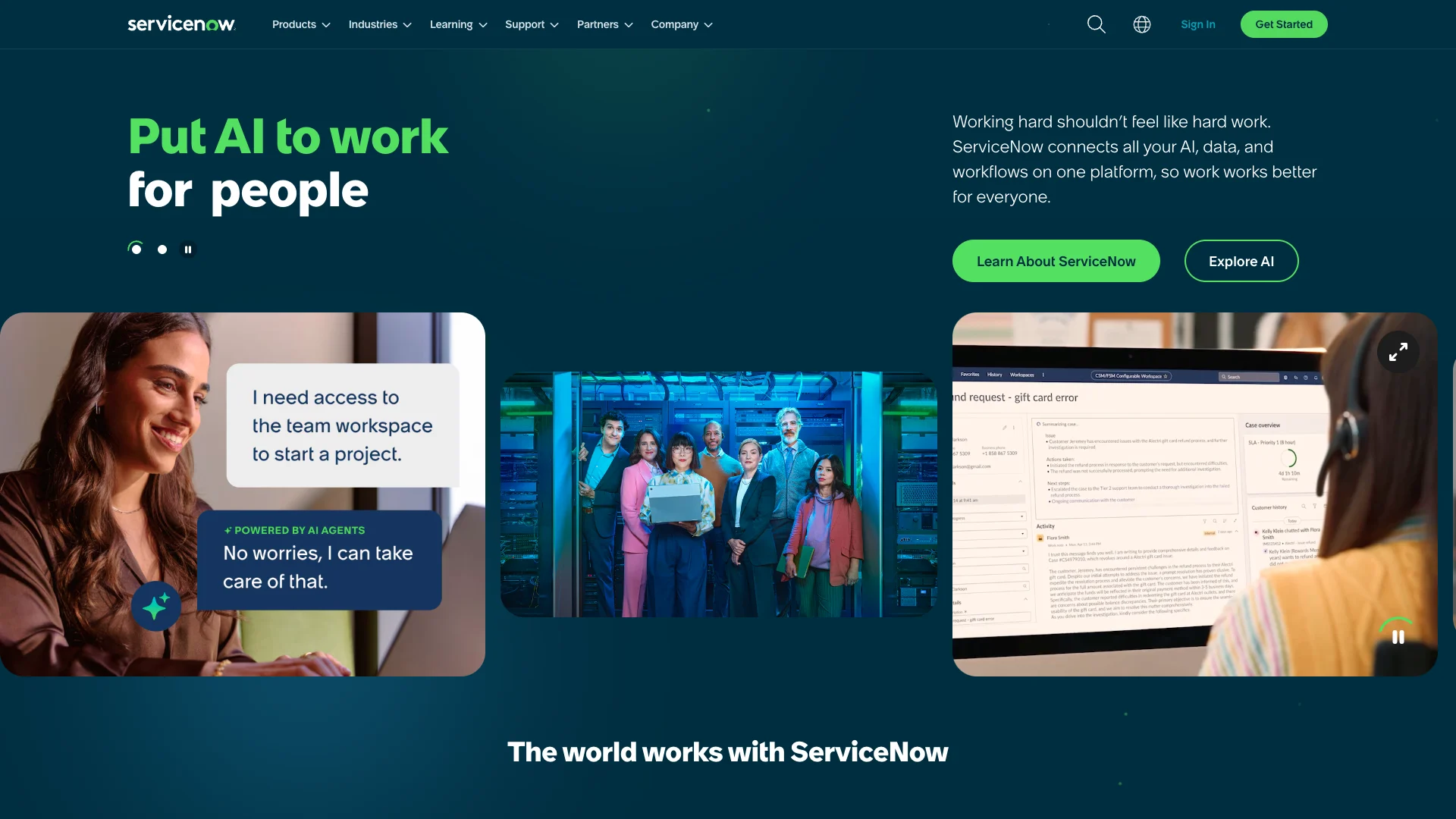
Next, ServiceNow is a comprehensive platform for managing all kinds of IT and other service management processes with AI. As part of this, it offers extensive functionality for handling incident management.
(ServiceNow Website)
This includes tools for major incident management, including embedded workflows to identify, track, and resolve incidents with the potential to have a large impact. It’s also a highly effective solution for centralizing data, giving agents a single-pane view of relevant information.
On top of this, it offers extensive capabilities for responding quickly to incidents, including response playbooks, incident priority calculations, omnichannel notifications, and more.
ServiceNow’s incident management tools are particularly impressive when it comes to implementing AI. Within their incident management suite, we can access tools for using agents to triage, route, and categorize reports, as well as close integration with AIOps.
There are also machine learning capabilities aimed at accelerating incident responses, including providing context for agents.
Across the wider ServiceNow platform, there’s also extensive scope for building AI-powered ITSM workflows more generally. This includes functionality for building and orchestrating agents, connecting to tools, implementing governance over internally and externally built agents, and much more.
As such, ServiceNow is a highly powerful, flexible solution for implementing AI within incident management processes, although some teams may find that its offering is surplus to their needs.
4. n8n
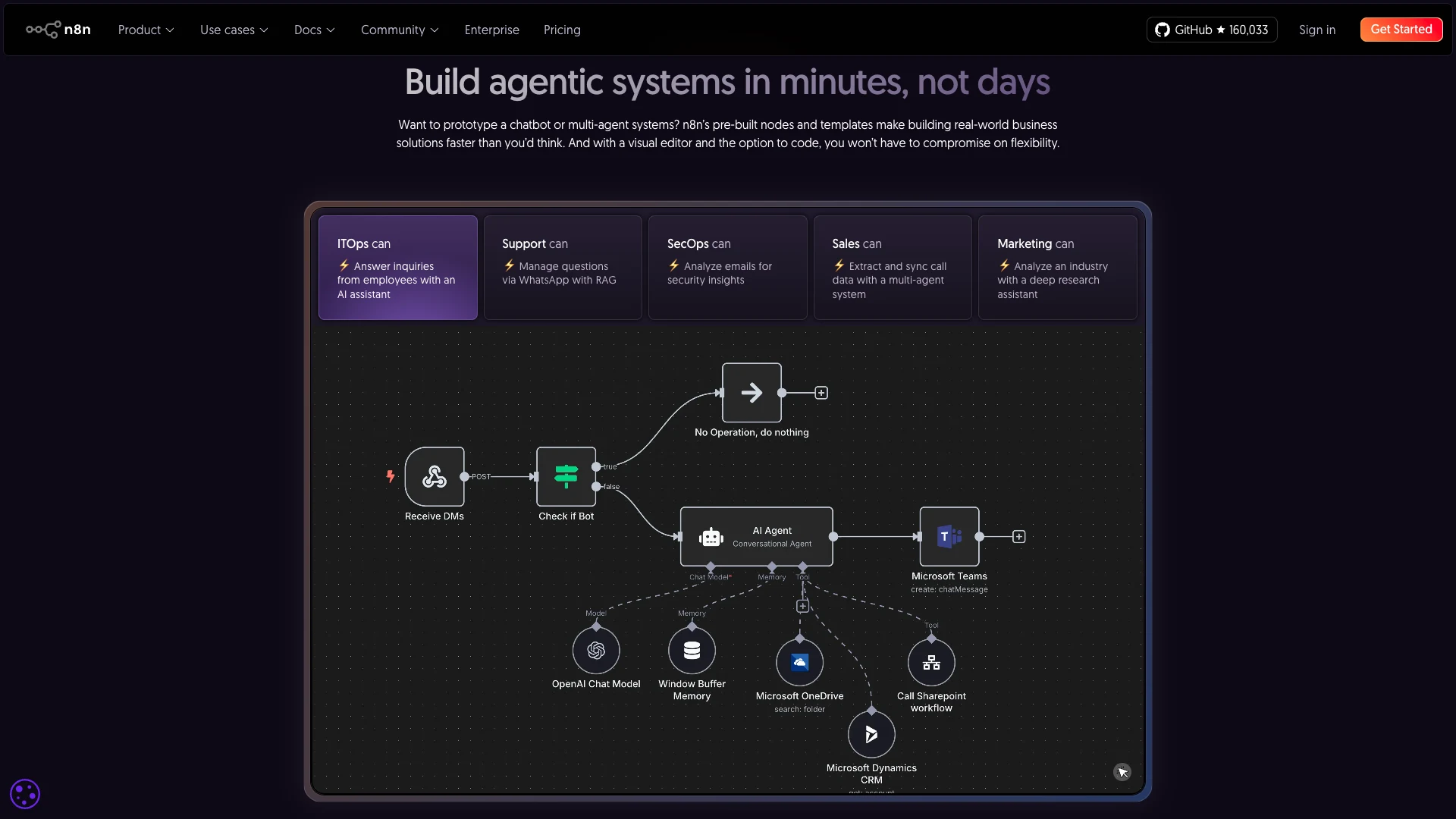
n8n is a slightly different proposition from some of the tools we’ve seen so far. It’s perhaps the best-known open-source, low-code platform for automating workflows of all kinds, including implementing AI.
(n8n Website)
This centers around a highly intuitive visual development experience, where we can configure workflow logic, agent behavior, API requests, and more. With the option of custom code, n8n is highly suitable for AI-powered automations in more technical teams and use cases.
It’s also a highly impressive platform when it comes to integrations. This includes over 1,200 pre-built connectors for common tools, including a range of IT, development, data, service management, and other types of platforms.
In terms of AI capabilities, n8n is highly attractive for providing intuitive experiences for connecting our existing tooling to custom AI agents.
As an open-source platform, it’s also self-hostable, which is often a firm requirement for many large teams with heightened security needs.
To help you get started, n8n offers a range of pre-built templates, including for several incident management workflows, such as triage, routing, and tasks across the wider incident lifecycle.
On the whole, n8n is a highly powerful, flexible platform that’s suitable for a range of complex use cases and workflows, although you may want to consider other options for more of a fully off-the-shelf AI incident management tool.
5. PagerDuty
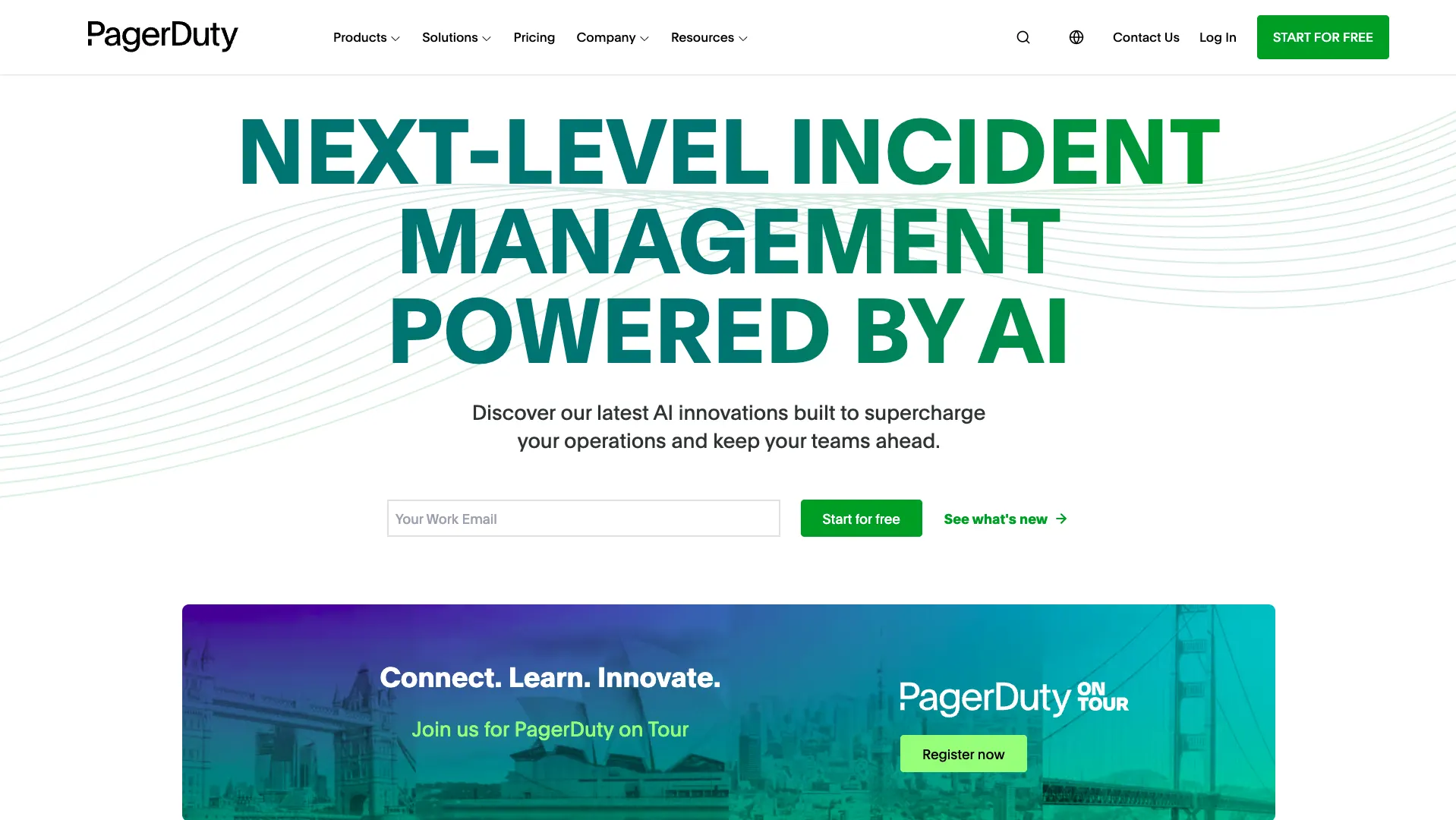
PagerDuty is undoubtedly one of the most ubiquitous names in the AI incident management space. This is a purpose-built platform for managing risks, incidents, service ops, and workflow automations.
(PagerDuty Website)
Within this, the incident management platform is highly suited to the needs of large enterprises. This includes capabilities for remediation, AIOps, runbook automation, stakeholder communications, and more.
PagerDuty offers highly configurable incident response workflows via a visual builder with a large number of triggers and actions, alongside extensive integrations with common ITSM and other related tools.
We can build resolution workflows that closely align with our organizational needs, with flexible user roles, assignment, and a range of internal communications tools.
It’s also a highly effective platform in terms of implementing AI for incident management, more specifically. Its AIOps functionality offers us several tools for more quickly and effectively identifying incidents, including using machine learning to enhance visibility and reduce alert noise.
On top of this, there are tools for utilizing generative AI and AI agents to automate repetitive tasks within incident management workflows.
As such, PagerDuty has the potential to be a highly attractive AI incident management solution for a range of different teams.
6. Freshservice
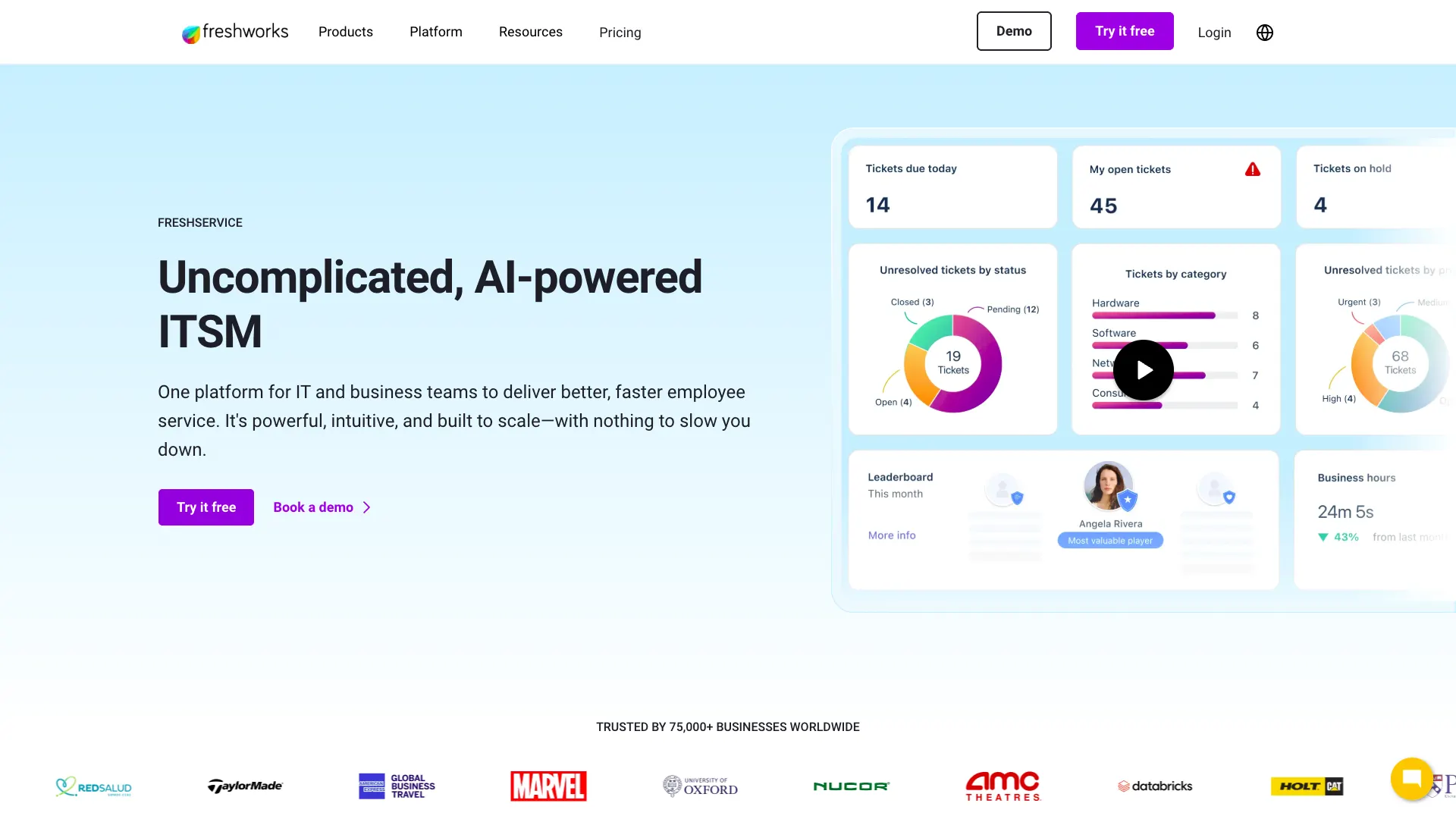
Lastly, we have Freshservice. This is a far-reaching, user-friendly ITSM platform with a range of helpful AI tools, including under the umbrella of incident management.
(Freshservice Website)
Freshservice is well-regarded for offering a comprehensive solution for managing IT service portfolios, with intuitive experiences for leveraging AI.
Within its incident management offering, Freshservice provides AI-driven detection, aimed at enabling us to identify incidents or potential incidents sooner, reducing risks, costs, and service disruption.
We can also utilize FreshWorks’ extensive routing, categorization, and triage capabilities to reduce the administrative work required to ensure that teams remain coordinated during incident responses.
Across the wider FreshWorks platform, FreddyAI provides agentic automations, assisting human service agents with information and AI-powered automations.
FreshWorks even offers AI-generated post-mortems, helping to solidify organizational learning as part of the incident management process.
On the whole, it’s a highly effective solution for teams that want to implement AI incident management as part of a wider ITSM platform, but we might want to look elsewhere for greater flexibility or to handle a smaller number of more specific workflows.
Turn data into action with Budibase
Budibase is the open-source, low-code platform that empowers IT teams to turn data into action.
With extensive external data support, autogenerated UIs, powerful AI-driven automation, optional self-hosting, custom RBAC, and more, Budibase is the complete toolkit for handling workflows securely.
Take a look at our features overview to learn more.